---
title: "Beyond One-Size-Fits-All: Building Flexible In-Vehicle Computing Platforms for Intelligent Transportation"
description: Intelligent transportation is reshaping in-vehicle computing. Learn how to match the right compute to each workload, and why flexible expansion—not one-size-fits-all hardware—defines the modern in-vehicle platform.
image: https://blog.dfi.com/hubfs/20260901_Beyond%20One-Size-Fits-All_In-Vehicle%20Platforms_1600x900px.jpg
---
[](https://www.dfi.com)
Tech in Days

- [Contact](https://www.dfi.com/contact/sales)
- [About us](https://www.dfi.com/about/companyinformation)
- [TW](https://blog.dfi.com/zh-tw/beyond-one-size-fits-all-building-flexible-in-vehicle-computing-platforms-for-intelligent-transportation)
EN

- Contact
- About Us
EN
- [TW](https://blog.dfi.com/zh-tw/beyond-one-size-fits-all-building-flexible-in-vehicle-computing-platforms-for-intelligent-transportation)
- [Innovation Spotlight](https://blog.dfi.com/en/tag/innovation-spotlight) 
- [Trend Watch](https://blog.dfi.com/en/tag/trend-watch) 
- [Success Showcase](https://blog.dfi.com/en/tag/success-showcase) 
Article Tag
- 


- [Innovation Spotlight](https://blog.dfi.com/en/tag/innovation-spotlight)
- [Trend Watch](https://blog.dfi.com/en/tag/trend-watch)
- [Success Showcase](https://blog.dfi.com/en/tag/success-showcase)
[Innovation Spotlight](https://blog.dfi.com/en/tag/innovation-spotlight) 2026/09/09
# Beyond One-Size-Fits-All: Building Flexible In-Vehicle Computing Platforms for Intelligent Transportation
Table of Content
## Transportation Challenge: Growing Integration Complexity
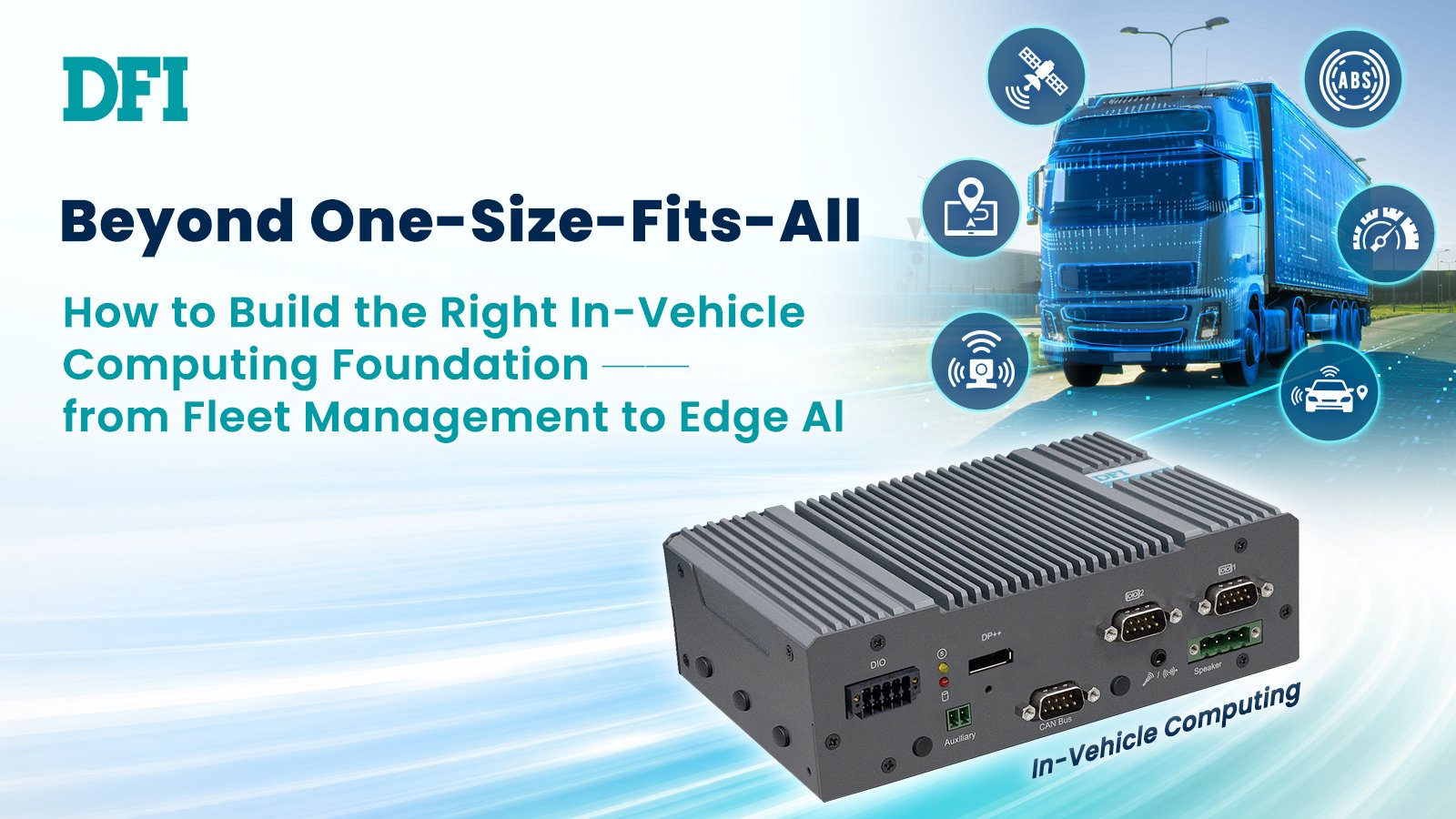
[According to Global Market Insights](https://www.gminsights.com/industry-analysis/intelligent-transportation-system-ITS-market), the global Intelligent Transportation System (ITS) market is expected to grow from USD 54.3 billion in 2026 to USD 135.3 billion by 2035, at a CAGR of 10.7%\[1\]. As the ITS market continues to expand, transportation applications are extending across a wider range of vehicle types and deployment scenarios, reshaping the role of in-vehicle computing.
As in-vehicle workloads expand from telematics and fleet management to real-time analytics and edge AI, transportation deployments require increasingly different levels of computing performance, connectivity, vehicle interfaces, and environmental protection. A fleet management deployment for a modern commercial truck, for example, may prioritize vehicle interfaces and connectivity. If it must also support compute-intensive workloads or operate in harsh conditions, greater computing performance and ruggedness may be required.
Such diverse requirements make a one-size-fits-all approach increasingly difficult across different vehicle types and deployment scenarios. When a single configuration does not match the workload, system integrators may need additional gateways or interface devices, increasing installation space, cabling, integration, and validation effort while making the in-vehicle architecture harder to adapt.
## Choose the Right In-Vehicle Platform
To move beyond a one-size-fits-all approach, DFI offers purpose-built in-vehicle platforms spanning multiple computing tiers—from vehicle data collection and fleet integration to high-performance edge AI in harsh environments. As in-vehicle applications extend into edge AI, differences in real-time processing and computing performance requirements become more pronounced, making it especially important to match each workload with the right compute. Beyond the right compute, a solution-ready platform must also provide the I/O, connectivity, expansion, and ruggedness required for each vehicle deployment. Together, these capabilities enable DFI platforms to address diverse in-vehicle application needs.
| Model | Challenge | **DFI Solution** | **Proof Pointn** | Key Specs |
| --- | --- | --- | --- | --- |
| VC900-M8M 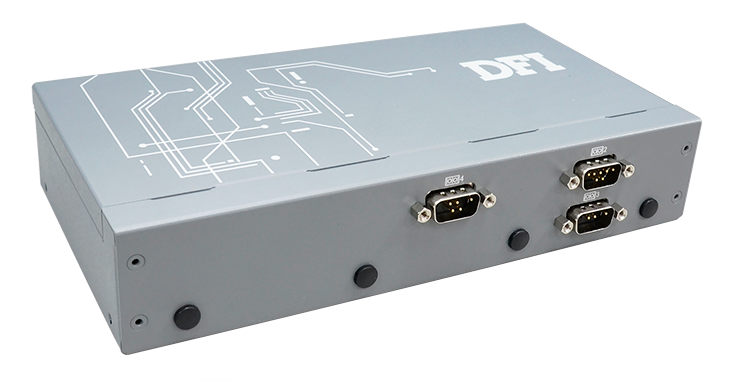 | Vehicle operating and motion data often come from separate sensors or interfaces. This complicates data collection, synchronization, and cloud transmission. | Consolidates vehicle data, motion sensing, and cloud connectivity on a single compact platform, reducing the need for separate interfaces and computing devices. | Served as the T-Box platform for vehicle data collection and cloud communication in [ARTC's Level 4 autonomous shuttle project.](https://blog.dfi.com/en/vc900-m8m-supports-artc-to-create-level-4-self-driving-electric-minibuses?hsLang=en) | NXP i.MX8M / 1× CAN Bus / 6-axis IMU / 1× GbE / 4× COM / 2× USB 3.1 Gen1 / 1× Micro USB (OTG) / 9–36V vehicle power input with ACC/IGN / fanless operation from -20°C to 70°C |
| VC700-ASL _1.png?width=1418&height=788&name=VC700-ASL(B%20side250618)_1.png) | Vehicle data, positioning, networking, and peripheral functions are often spread across separate systems, making system connectivity and integration more difficult. | Integrates vehicle data, positioning, networking, and peripheral connectivity on a single ultra-compact platform, reducing cabling while minimizing architecture changes to lower retrofit complexity as well as multi-system integration effort. | Enabled existing patrol vehicles to add edge computing, positioning, connectivity, and AI capabilities in a [European police fleet modernization project.](https://blog.dfi.com/en/modernizing-european-police-fleets-the-impact-of-dfi-vc700-asl?hsLang=en) | Intel® Atom® X7000RE Series / 2× CAN 2.0B (CAN FD available upon request) / J1939 / GNSS / 2× GbE (M12 X-code) / built-in OOB remote management / 2× Mini-PCIe / 3× M.2 expansion. |
| VCX700-MTH _w600.png?width=600&height=480&name=VCX700-MTH(Side250605)_w600.png) | Edge AI and other advanced in-vehicle applications require higher computing performance, but harsh deployment environments can make it difficult for existing platforms to deliver both high performance and reliable operation. | Combines Intel® Core™ Ultra processing with an IP67-rated fanless ruggedized design and wide-temperature operation, delivering high-performance computing with reliable operation in harsh in-vehicle environments. | A ruggedized AI Box PC integrated with VicOne’s security solution, that combines edge AI and automotive cybersecurity for intelligent transportation and fleet management. | Intel® Core™ Ultra / IP67-rated fanless ruggedized design / built-in 9-axis sensor / wide-temperature from -40°C to 70°C / 2× CAN FD / 3× M.2 expansion / 9–36V vehicle power input with ACC/IGN |
---
## Modular Expansion: Adapt to Changing Deployment Needs
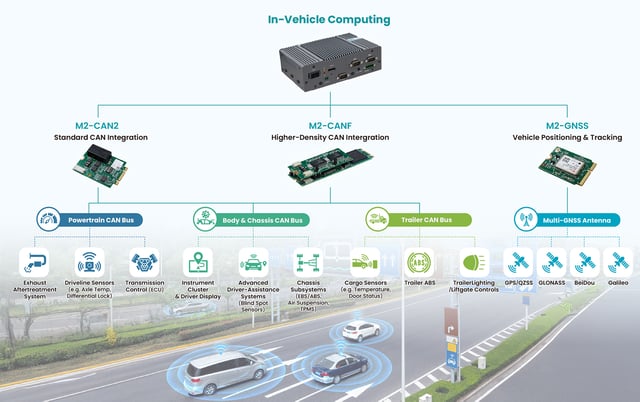
The three DFI in-vehicle systems introduced above provide computing foundations for different workloads—from telematics and fleet integration to rugged edge AI. After selecting the system that best matches the workload, system integrators can extend compatible platforms with DFI’s M.2 modules according to the vehicle interfaces and capabilities required for each application.
M2-CAN2 and M2-CANF support different scales of CAN/CAN FD integration, while M2-GNSS adds multi-constellation positioning for location- and tracking-based applications. This system-and-module approach allows system integrators to adapt the selected DFI system to specific deployment requirements by adding only the vehicle interfaces and capabilities needed for each application.
- Typical Expansion Needs
**Powertrain Integration:** Additional CAN channels may be required to connect transmission control units, driveline sensors, and exhaust aftertreatment systems. M2-CAN2 or M2-CANF can add the required CAN/CAN FD connectivity, depending on the number of vehicle systems and CAN networks involved.
**Body & Chassis Integration:** Multiple CAN networks may be required to connect instrument clusters, driver displays, ADAS sensors, EBS/ABS, air suspension, TPMS, and other subsystems. For deployments involving more ECUs or CAN networks, M2-CANF adds CAN/CAN FD channels while reducing reliance on separate external interface devices.
**Trailer Integration:** Dedicated CAN connectivity may be required for trailer lighting, liftgate controls, trailer ABS, and cargo sensors such as temperature or door-status monitoring. M2-CAN2 or M2-CANF can add the required connectivity according to the number of trailer devices and CAN networks involved.
**Vehicle Positioning & Tracking:** When vehicle positioning, tracking, or route management is required, M2-GNSS adds multi-constellation positioning through a compact M.2 module supporting GPS/QZSS, GLONASS, BeiDou, and Galileo.
- Combining CAN and GNSS for Advanced Fleet Operations
On compatible DFI systems with multiple M.2 expansion slots, CAN and GNSS modules can be installed simultaneously. CAN connectivity provides access to vehicle operating and status data, while GNSS adds location and movement information. Together, these data sources provide a system-level foundation for integrated fleet operations, spanning from vehicle condition monitoring and fleet tracking to route optimization and dispatch, while also supporting predictive maintenance analysis.
- In-Vehicle Expansion Module Guide
| Criteria | M2-CAN2 | M2-CANF | M2-GNSS |
| --- | --- | --- | --- |
| Best For | Standard CAN Integration | Higher-Density CAN Integration | Vehicle Positioning |
| Capability | 2× CAN 2.0A/2.0B/FD | 4× CAN 2.0A/2.0B/FD | GPS/QZSS L1 C/A, GLONASS L10F, BeiDou B1I, Galileo E1B/C |
| Choose When | Fewer CAN devices / subsystems need to be integrated | Multiple ECUs / CAN networks need to be integrated | Vehicle location / tracking is required |
| Form Factor | M.2 3042 B+M Key, PCIe or USB 2.0 (by SKU) | M.2 2280 M Key, PCIe | M.2 2230 E Key, USB 2.0 |
---
## **What a Flexible In-Vehicle Architecture Enables**
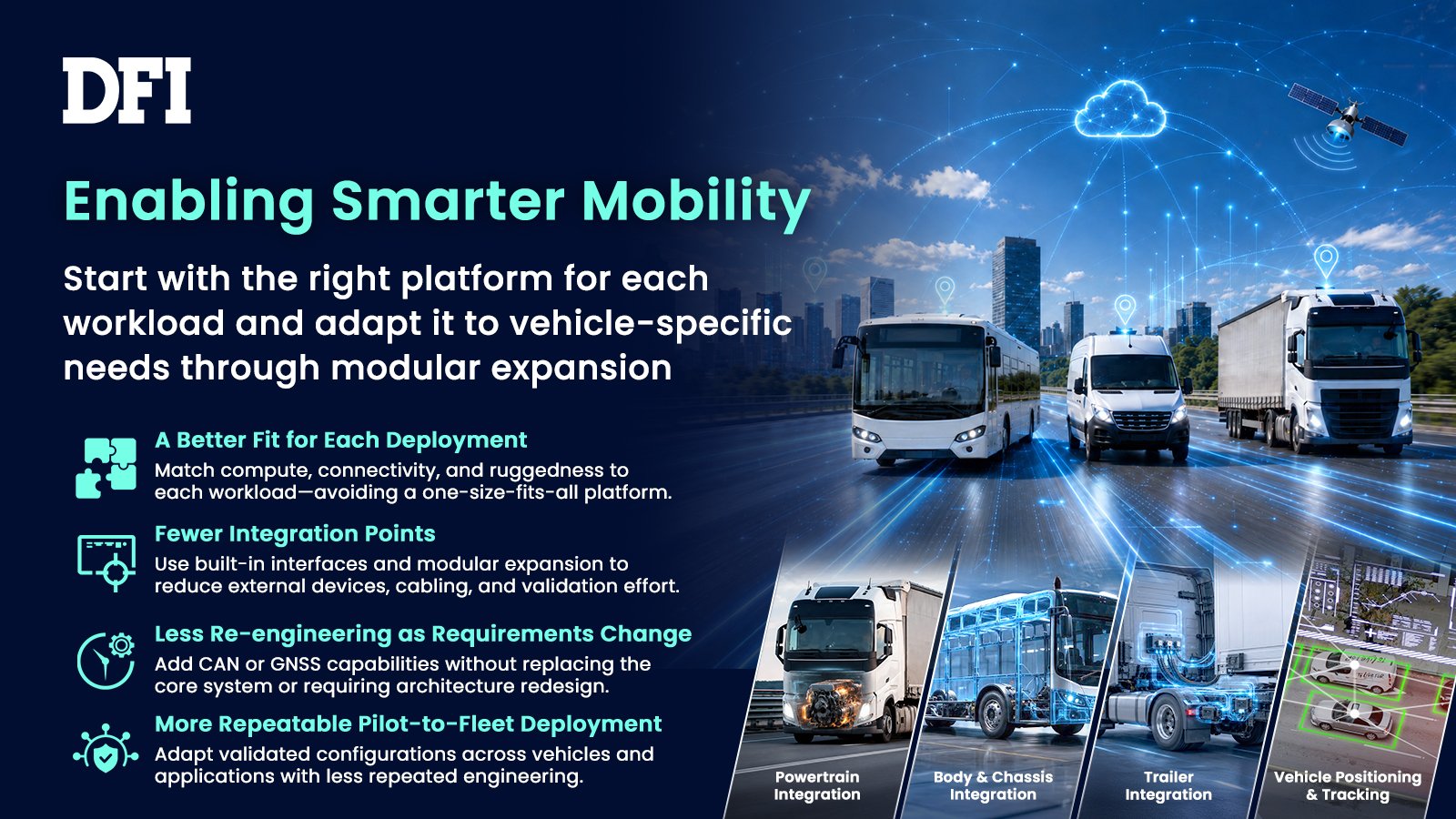
By combining a workload-aligned base platform with modular vehicle-interface expansion, DFI gives system integrators two levels of flexibility: selecting the right computing foundation first, then adapting it to vehicle-specific requirements. Together, these capabilities deliver four practical benefits:
- **A Better Fit for Each Deployment**
System integrators can select the level of computing performance, connectivity, and ruggedness required for each workload, avoiding a one-size-fits-all platform approach.
- **Fewer Integration Points
Built-in vehicle interfaces, positioning, connectivity, and I/O—supplemented by expansion modules where needed—can reduce reliance on separate gateways and interface devices, simplifying cabling and system validation.**
- **Less Re-engineering as Requirements Change**
On compatible platforms, additional CAN or GNSS capabilities can be introduced without replacing the core computing system, helping preserve the validated system architecture as deployment requirements evolve.
- **More Repeatable Pilot-to-Fleet Deployment**
Once a platform configuration has been validated, it can be adapted for related vehicle models and application scenarios, reducing repeated engineering work as projects move from pilot validation to broader fleet deployment.
## **Outcomes**
DFI addresses in-vehicle deployment needs at multiple levels. Customers can select a Commercial Off-The-Shelf (COTS) platform that matches the workload and extend the required vehicle interfaces and capabilities through modular M.2 expansion. DFI also provides Design Manufacturing Service (DMS), supporting customer-specific needs from customization and system integration to validation and production. Together, these capabilities provide a deployment-ready in-vehicle computing foundation for diverse vehicle types and deployment requirements—delivering the right compute for every vehicle and flexible expansion for every deployment.
[](https://blog.dfi.com/hs/cta/wi/redirect?encryptedPayload=AVxigLJypyR9inq0Qt%2FvHlJDAub%2FTa1IrW7GsTrFHXYaSvyMHoiyexx1ch2zZNPOVzpXAPjWwUXzb6gFTyU8RCTiahmiNaNY6noPAS2l%2B2RaQhFE0L2MweugjLhFx8ye7KoOKeasG8iMAVYC%2Bl%2FrJixrvc9qb3dBxwQM7spDENU0M%2BA%2FWGF9DqP3RczUJJzy7lGF58Uz2yPDtC8w8uY%3D&webInteractiveContentId=206341415547&portalId=8330016&hsLang=en)
 [DFI Editorial Team](https://blog.dfi.com/en/author/dfi-editorial-team)
The DFI Editorial Team specializes in embedded solutions for industrial automation, energy, transportation, medical, gaming, mission-critical, and intelligent retail sectors, providing expert insights into DFI’s innovations.
##### Share
 [](https://www.linkedin.com/sharing/share-offsite/?url=https://blog.dfi.com/en/beyond-one-size-fits-all-building-flexible-in-vehicle-computing-platforms-for-intelligent-transportation) [](http://twitter.com/share?url=https://blog.dfi.com/en/beyond-one-size-fits-all-building-flexible-in-vehicle-computing-platforms-for-intelligent-transportation) [](https://www.facebook.com/sharer/sharer.php?u=https://blog.dfi.com/en/beyond-one-size-fits-all-building-flexible-in-vehicle-computing-platforms-for-intelligent-transportation)
##### Related Tags
[Innovation Spotlight](https://blog.dfi.com/en/tag/innovation-spotlight) [Transportation](https://blog.dfi.com/en/tag/transportation) [Edge AI](https://blog.dfi.com/en/tag/edge-ai)
### Get the latest from DFI.
Keep up to date with our latest news and analysis by subscribing to our regular newsletter.

COPYRIGHT © DFI 2026. ALL RIGHTS RESERVED.
[Privacy Policy](https://www.dfi.com/privacypolicy) [Site Map](https://www.dfi.com/sitemap)
Follow us
-
-
-
-
```json
{
"@context" : "https://schema.org",
"@type" : "BlogPosting",
"author" : {
"@type" : "Person",
"name" : "DFI Editorial Team",
"url" : "https://blog.dfi.com/en/author/dfi-editorial-team"
},
"dateModified" : "2026-09-09T03:00:00.467Z",
"datePublished" : "2026-09-09T03:00:00.000Z",
"headline" : "Beyond One-Size-Fits-All: Building Flexible In-Vehicle Computing Platforms for Intelligent Transportation",
"image" : [ "https://blog.dfi.com/hubfs/20260901_Beyond%20One-Size-Fits-All_In-Vehicle%20Platforms_1600x900px.jpg" ],
"mainEntityOfPage" : {
"@id" : "https://blog.dfi.com/en/beyond-one-size-fits-all-building-flexible-in-vehicle-computing-platforms-for-intelligent-transportation",
"@type" : "WebPage"
},
"publisher" : {
"@type" : "Organization",
"logo" : {
"@type" : "ImageObject",
"url" : "https://blog.dfi.com/hubfs/DFI-Logo-2.png"
},
"name" : "DFI Inc."
}
}
```
```json
{
"@context" : "https://schema.org",
"@type" : "FAQPage",
"mainEntity" : [ {
"@type" : "Question",
"acceptedAnswer" : {
"@type" : "Answer",
"text" : "AI that perceives and acts in the physical world — integrating models, sensors, and onboard compute so a machine can understand its environment and take meaningful action."
},
"name" : "What is Physical AI?"
}, {
"@type" : "Question",
"acceptedAnswer" : {
"@type" : "Answer",
"text" : "Traditional automation repeats a fixed task on a set path; Physical AI robots sense, reason, and adapt."
},
"name" : "How is it different from automation?"
}, {
"@type" : "Question",
"acceptedAnswer" : {
"@type" : "Answer",
"text" : "A robot acting in real time can't wait on a data-center round-trip — latency, reliability, bandwidth, and privacy push intelligence onto the machine, which is what edge AI for robots means in practice."
},
"name" : "Why edge computing, not cloud?"
}, {
"@type" : "Question",
"acceptedAnswer" : {
"@type" : "Answer",
"text" : "Different compute at each Sense–Think–Act stage: high-bandwidth I/O and sync for sensing, GPU/NPU for reasoning, real-time deterministic control for action."
},
"name" : "What compute does a robot need?"
}, {
"@type" : "Question",
"acceptedAnswer" : {
"@type" : "Answer",
"text" : "By matching each node to the right platform class, while prioritizing longevity, wide-temperature operation, real-time capability, and security."
},
"name" : "How do OEMs choose a robot compute platform?"
}, {
"@type" : "Question",
"acceptedAnswer" : {
"@type" : "Answer",
"text" : "An AGV follows fixed routes; an AMR navigates dynamically with onboard sensing and AI — which is why AMRs need more onboard compute."
},
"name" : "What is the difference between an AMR and an AGV?"
} ]
}
```