---
title: DFI EC543-ADS Industrial Computer Powers the Brain of The Nuclear Power Plants
description: Discover how DFI's EC543-ADS Industrial Computer is transforming nuclear power plants with cutting-edge technology for enhanced safety, efficiency, and digitalization.
image: https://blog.dfi.com/hubfs/20260717_Success%20Showcase_MMIS%20Console%20Workstation%20for%20Nuclear%20Power%20Plants_EC543-ADS_1600x900px.jpg
---
[](https://www.dfi.com)
Tech in Days

- [Contact](https://www.dfi.com/contact/sales)
- [About us](https://www.dfi.com/about/companyinformation)
- [TW](https://blog.dfi.com/zh-tw/dfi-ec543-ads-工業級運算系統打造核電廠的智慧大腦)
EN

- Contact
- About Us
EN
- [TW](https://blog.dfi.com/zh-tw/dfi-ec543-ads-工業級運算系統打造核電廠的智慧大腦)
- [Innovation Spotlight](https://blog.dfi.com/en/tag/innovation-spotlight) 
- [Trend Watch](https://blog.dfi.com/en/tag/trend-watch) 
- [Success Showcase](https://blog.dfi.com/en/tag/success-showcase) 
- 


- [Innovation Spotlight](https://blog.dfi.com/en/tag/innovation-spotlight)
- [Trend Watch](https://blog.dfi.com/en/tag/trend-watch)
- [Success Showcase](https://blog.dfi.com/en/tag/success-showcase)

[Success Showcase](https://blog.dfi.com/en/tag/success-showcase) 2026/07/22
# DFI EC543-ADS Industrial Computer Powers the Brain of The Nuclear Power Plants
Table of Content
# Surging Energy Demand Pushes Power Plants Toward Digitalization
The exponential rise of AI data centers and the relentless expansion of manufacturing have driven global electricity demands to unprecedented heights. This surging consumption puts immense strain on legacy electrical grids and power generation facilities worldwide. To safely navigate this high-demand era, power plants—particularly nuclear facilities—are aggressively undergoing a digital evolution. Modern utilities require robust Edge AI architectures with a "smart brain" capable of handling real-time operational control, automated fault diagnostics, predictive maintenance forecasting, and even complex simulations for safety scenarios or new feature testing.
Within this landscape, the global Industrial PC (IPC) market for the energy and utilities sector is experiencing an accelerated transformation. Critical infrastructure operators are no longer searching for standard hardware; they are demanding ruggedized, highly secure, and regulatory-compliant edge computing platforms capable of driving AI capabilities into legacy nuclear facilities while ensuring operational safety in the most unforgiving environments. According to industry forecasts from [Global Market Insights](https://www.gminsights.com/industry-analysis/industrial-pc-market), the energy and power segment in the IPC market is projected to expand at a CAGR of 4.6%, reaching USD 863 million by 2035.
Industry: Energy / Nuclear Power
Country: One APAC nation
Application: MMIS Console Workstation for Nuclear Facilities
Solution: DFI EC543-ADS Embedded Industrial Computer
## Industrial Might and the Nuclear Renaissance
As the world's primary manufacturing hub, Asia consumes roughly half of all global electricity. Because immense demand often outpaces domestic capacity, many nations rely heavily on foreign energy imports, placing them at a critical economic and energy crossroads.
This APAC nation serves as a prime example of this complex challenge. As a global manufacturing leader across several advanced industries, the nation possesses an immense appetite for electricity. However, its economic engine faces a distinct vulnerability: the nation relies on overseas imports for a significant share of its energy supply.
To secure long-term economic resilience, grid stability, and energy independence, the national government has renewed its commitment to nuclear energy in recent years, moving forward with new projects and upgrades to existing reactors. The country is now aggressively upgrading and digitalizing its nuclear infrastructure to enhance power generation efficiency and achieve technological independence.
## Challenges of Building the Brain of a Nuclear Reactor
Within a nuclear power plant, the main control room serves as the absolute core of the facility’s infrastructure. Since a single oversight can cause catastrophic, irreversible consequences, every device and subsystem must be continuously monitored and precisely controlled.
To master this monumental task, a customer in the APAC region designed an advanced Man-Machine Interface System (MMIS) to serve as the facility's “smart brain.” This highly sophisticated system manages overall instrumentation, plant operations, real-time telemetry, emergency safety functions, and even complex simulations for accident scenarios. As the primary interface, the MMIS empowers control room operators to flawlessly monitor the nuclear reactor core and its vast network of interconnected sub-systems.
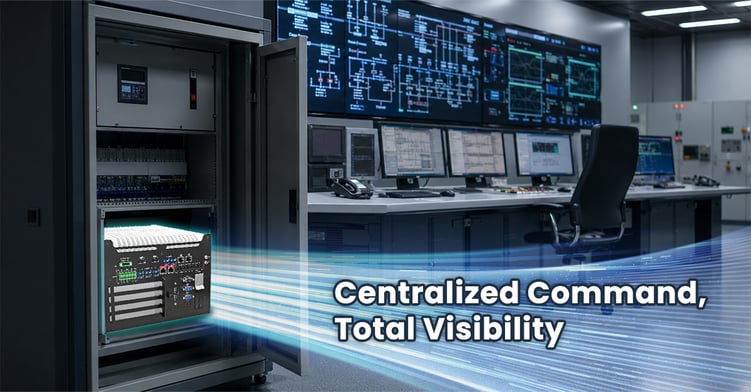
However, hosting this vital MMIS framework requires console workstations built to meet an uncompromising set of hardware design challenges:
● Uncompromising Reliability & Redundancy: Since a failure in an MMIS workstation can blind operators to critical reactor data, the hardware must deliver fail-safe, continuous 24/7/365 uptime.
● Ruggedized Longevity: Nuclear power plants operate on lifecycles spanning decades. The underlying Industrial computer must offer exceptional quality, durability, long-term life support and strict revision management to match these extended lifespans.
● Rigid Safety & Electrical Isolation Standards: To safeguard the control room against catastrophic failures, the hardware must incorporate robust passive safety protections, including strict flame retardancy and power isolation to prevent grid faults or fires from spreading.
With over 40 years of experience in industrial computer design, DFI harnessed its deep expertise in the energy sector and AI edge computing to support the customer with building the advanced MMIS and migrate their legacy infrastructure into a smarter, more secure architecture.
## [DFI EC543-ADS](https://www.dfi.com/product/index/1648) Industrial Computer: Powering Nuclear MMIS Consoles Beyond Basic Functionality
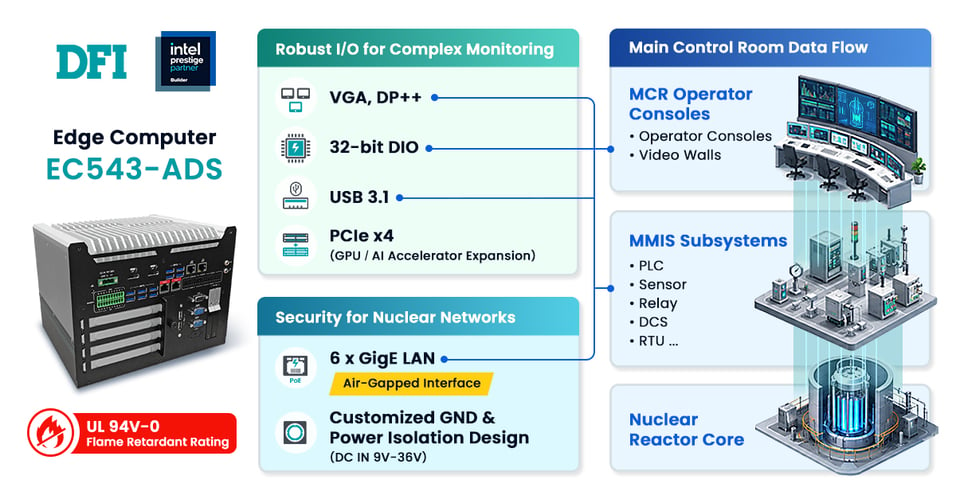
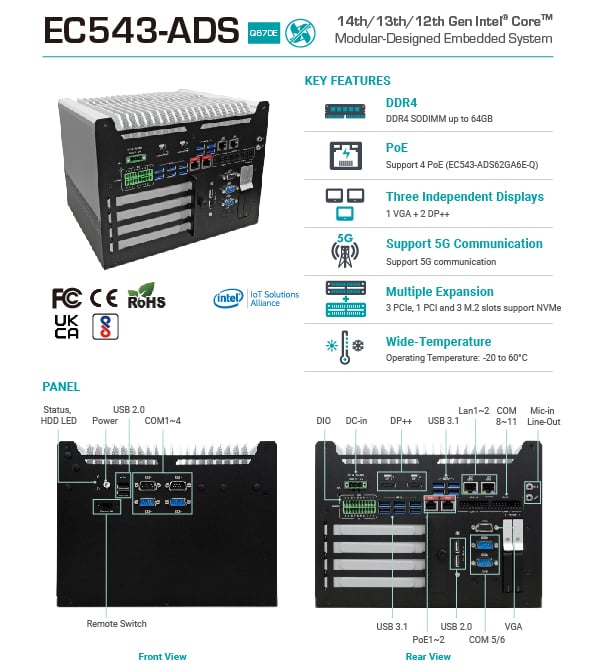
At the core of upgrading the MMIS console workstations was the DFI EC543-ADS embedded industrial computer. The platform delivers an optimal blend of high-performance computing, rich connectivity, and stringent safety protections, while providing edge AI power to drive complex simulations for accident scenarios and feature validation.
### **Next-Gen Processing Power**
Powered by 14th/13th/12th Gen Intel® Core™ processors and the Intel® Q670E chipset, the EC543-ADS provides the robust compute capability required to process massive data streams, execute AI algorithms for diagnostics, and handle real-time visualization concurrently. This ensures operators maintain total visibility across every facet of the facility, empowering them to troubleshoot anomalies immediately, maximize plant uptime, and streamline long-term maintenance.
### **Centralized Control via Rich I/O**
The EC543-ADS embedded system features an expansive array of industrial connectivity options. The 32-bit Digital Input/Output (DIO) interface allows the workstation to seamlessly bridge and centralize control over diverse field devices, while the onboard VGA and DP++ ports visualize the aggregated operational data onto a unified display interface for operators.
### **Air-Gapped Network Security & Fault Isolation**
To guarantee absolute security within the facility's network and protect core infrastructure from external threats or internal voltage spikes, DFI designed the EC543-ADS with six independent LAN ports backed by a custom Ground (GND) design. This specialized hardware architecture enables seamless redundant data transmission across multiple paths while maintaining strict physical network isolation (air-gapping).
By separating critical safety networks from secondary diagnostic lines at the hardware level, the core control infrastructure remains completely insulated from external network vulnerabilities and localized electrical faults. Furthermore, compliance with the Cyber Resilience Act (CRA) seamlessly blends this hardware-level network isolation with rigid firmware-level protections, delivering robust security throughout the system's operational lifecycle.
### **Strictest Fire Safety Compliance**
Passive safety is paramount in mission-critical control rooms. The DFI EC543-ADS achieves the stringent UL 94V-0 Flame Retardant Rating, the industry’s highest standard for vertical burn flammability. This certification guarantees that any burning self-extinguishes within 10 seconds on a vertical specimen, ensuring the chassis and its internal components will not propagate fire or sustain a flame during an extreme electrical fault.
### **Future-Proof Edge AI Expansion**
With versatile PCIe expansion slots, the DFI EC543-ADS workstation supports high-performance GPUs to drive AI capabilities across power plant operations. This allows facilities to seamlessly scale their Edge AI capabilities, such as deploying advanced predictive maintenance, simulating safety and accident scenarios, or conducting simulated testing for changing components or new features, right from the control room floor.
## Expertise & Premium Services as a Long-Term Partner
With DFI’s powerful and reliable industrial computers and hands-on engineering support, the client successfully deployed the cutting-edge MMIS consoles, transforming legacy nuclear power plants into modern, fully digitized facilities. This complex modernization was achieved seamlessly due to two core pillars:
### **High Compatibility for Seamless Digital Transformation**
Integrating modern hardware into legacy facilities is always a significant challenge for power plants due to disparate I/O standards, conflicting protocols, and mismatched operating systems or drivers. DFI eliminates these bottlenecks through the highly compatible design of its industrial computers, backed by specialized support for custom firmware and software integration.
In this deployment, the robust compatibility of the DFI's EC543-ADS embedded system allowed the customer to seamlessly interface with existing field devices without changing the nuclear plant's core legacy hardware. This not only streamlined and accelerated the integration process, but also provided a quick upgrade to the nuclear facility with Edge AI capabilities, unlocking low-latency data processing, real-time decision-making, and automated protective actions for mission-critical nuclear safety.
### **Trusted Long-Term Support for Critical Infrastructure**
Apart from compatibility, extended product lifecycle support is vital for nuclear power plants, which are typically designed to operate for more than 40 years. In this highly regulated industry, altering even a single hardware component can trigger an expensive, time-consuming system re-certification process.
DFI eliminates this operational risk through strict revision control and guaranteed long-term product life support, delivering uncompromising reliability for everyday plant operations. This saved the customer significant hidden re-certification costs and secured the long-term operational stability of their critical nuclear energy footprint for decades to come.
Following the resounding success of the MMIS consoles, the customer affirmed DFI's expertise and dedicated engineering support. They have entered a long-term strategic partnership with DFI to modernize the facility's remaining field infrastructure, paving the way for a comprehensive, plant-wide digital transformation.
## Download Success Story
[](https://blog.dfi.com/hs/cta/wi/redirect?encryptedPayload=AVxigLJub7JWP4G7IV8oDbl74Kok7PcpdOYf9fT0%2FVqRFIYuCDxMUmzB%2FJTABQV0B%2FI3zLQsYQaoMnIM7FnJ9Qe9dz6vkrh8CtmAiQB1e%2BEg9%2Fsc8%2F9tenAI9F6BUX%2FhDjprNYueTuQYql1FkUuPB3qmyqPeMM%2BymQRTdL9phKLguHuBZ8cNdMviI70mlF%2BoHFiz1XuKztRR1%2BYjtqyMaOjDBpeApAs2qkV8rfpEK5vVDdRoiHPrQHwFGYkfDxaudTexxeKrq69vURwCLZLjxXxnsIR%2BVsRWkPFu2vFal34QUydMijWIu6GHXknwcX11NIZ31Jk%3D&webInteractiveContentId=217591968663&portalId=8330016&hsLang=en)
 [DFI Editorial Team](https://blog.dfi.com/en/author/dfi-editorial-team)
The DFI Editorial Team specializes in embedded solutions for industrial automation, energy, transportation, medical, gaming, mission-critical, and intelligent retail sectors, providing expert insights into DFI’s innovations.
##### Share
 [](https://www.linkedin.com/sharing/share-offsite/?url=https://blog.dfi.com/en/dfi-ec543-ads-industrial-computer-powers-the-brain-of-the-nuclear-power-plants) [](http://twitter.com/share?url=https://blog.dfi.com/en/dfi-ec543-ads-industrial-computer-powers-the-brain-of-the-nuclear-power-plants) [](https://www.facebook.com/sharer/sharer.php?u=https://blog.dfi.com/en/dfi-ec543-ads-industrial-computer-powers-the-brain-of-the-nuclear-power-plants)
##### Related Tags
[Energy](https://blog.dfi.com/en/tag/energy) [Success Showcase](https://blog.dfi.com/en/tag/success-showcase)
### Get the latest from DFI.
Keep up to date with our latest news and analysis by subscribing to our regular newsletter.

COPYRIGHT © DFI 2026. ALL RIGHTS RESERVED.
[Privacy Policy](https://www.dfi.com/privacypolicy) [Site Map](https://www.dfi.com/sitemap)
Follow us
-
-
-
-
```json
{
"@context" : "https://schema.org",
"@type" : "BlogPosting",
"author" : {
"@type" : "Person",
"name" : "DFI Editorial Team",
"url" : "https://blog.dfi.com/en/author/dfi-editorial-team"
},
"dateModified" : "2026-07-22T01:00:00.276Z",
"datePublished" : "2026-07-22T01:00:00.000Z",
"headline" : "DFI EC543-ADS Industrial Computer Powers the Brain of The Nuclear Power Plants",
"image" : [ "https://blog.dfi.com/hubfs/20260717_Success%20Showcase_MMIS%20Console%20Workstation%20for%20Nuclear%20Power%20Plants_EC543-ADS_1600x900px.jpg" ],
"mainEntityOfPage" : {
"@id" : "https://blog.dfi.com/en/dfi-ec543-ads-industrial-computer-powers-the-brain-of-the-nuclear-power-plants",
"@type" : "WebPage"
},
"publisher" : {
"@type" : "Organization",
"logo" : {
"@type" : "ImageObject",
"url" : "https://blog.dfi.com/hubfs/DFI-Logo-2.png"
},
"name" : "DFI Inc."
}
}
```