---
title: "From Automation to Physical AI: How Intelligent Robots Are Reshaping Industrial Operations"
description: Physical AI is reshaping industrial robots. Learn how to match the right compute to each Sense–Think–Act node, and why edge AI—not raw CPU power—defines the modern robot compute platform.
image: https://blog.dfi.com/hubfs/20260811_Trend%20Watch-From%20Automation%20to%20Physical%20AI_%E5%9C%961_1600x900px.jpg
---
[](https://www.dfi.com)
Tech in Days

- [Contact](https://www.dfi.com/contact/sales)
- [About us](https://www.dfi.com/about/companyinformation)
- [TW](https://blog.dfi.com/zh-tw/from-automation-to-physical-ai-how-intelligent-robots-are-reshaping-industrial-operations)
EN

- Contact
- About Us
EN
- [TW](https://blog.dfi.com/zh-tw/from-automation-to-physical-ai-how-intelligent-robots-are-reshaping-industrial-operations)
- [Innovation Spotlight](https://blog.dfi.com/en/tag/innovation-spotlight) 
- [Trend Watch](https://blog.dfi.com/en/tag/trend-watch) 
- [Success Showcase](https://blog.dfi.com/en/tag/success-showcase) 
- 


- [Innovation Spotlight](https://blog.dfi.com/en/tag/innovation-spotlight)
- [Trend Watch](https://blog.dfi.com/en/tag/trend-watch)
- [Success Showcase](https://blog.dfi.com/en/tag/success-showcase)
[Trend Watch](https://blog.dfi.com/en/tag/trend-watch) 2026/08/14
# From Automation to Physical AI: How Intelligent Robots Are Reshaping Industrial Operations
Table of Content
Industrial robots are evolving from fixed automation into intelligent machines that perceive, reason, and act. Here's how Physical AI is reshaping industrial operations — and what OEMs must weigh when designing the robot compute platform behind the next generation of robots.
## Physical AI Is Rising: The Next Step in Industrial Automation
Industry 4.0 connected machines and digitized production data. Physical AI takes the next step — enabling machines to perceive their physical environment, make decisions, and respond autonomously.
The signs are already visible across industry. At GTC 2026, NVIDIA's Jensen Huang declared that "every industrial company will become a robotics company" [\[1\]](https://blog.dfi.com/en/from-automation-to-physical-ai-how-intelligent-robots-are-reshaping-industrial-operations#Reference). The numbers echo the message: 542,076 industrial robots were installed worldwide in 2024, lifting the global operational fleet to roughly 4.66 million [\[2\]](https://blog.dfi.com/en/from-automation-to-physical-ai-how-intelligent-robots-are-reshaping-industrial-operations#Reference), while robotics and physical-AI startups drew about US$27.6 billion in venture funding in 2025 — with humanoid funding alone more than tripling year over year [\[3\], \[4\]](https://blog.dfi.com/en/from-automation-to-physical-ai-how-intelligent-robots-are-reshaping-industrial-operations#Reference).
Beneath the headlines is a structural shift. Robots are moving from machines that execute pre-programmed tasks to systems that perceive their surroundings and decide how to act — which makes the computer inside the machine the core of the design, not an accessory.
For robot OEMs and system integrators, this reframes Physical AI as a system-architecture challenge: placing the right compute at the right node while maintaining deterministic performance, industrial reliability, cybersecurity, expandability, and long-term serviceability. That is the problem DFI's robot compute platforms are built to address.
From Automation to Autonomy
What actually changes between a traditional automated machine and a Physical AI robot?
| Traditional Automation | Physical AI robot |
| --- | --- |
| Fixed path | Adaptive navigation |
| Rule-based logic | AI-based reasoning |
| PLC control | AI compute |
| Safety fence | Human collaboration |
| Repeats a task | Perceives, learns, decides |
The difference isn't only intelligence — it's where the intelligence lives and how the machine is built around it.
## **Sense · Think · Act: The Compute Architecture Behind Physical AI**
Strip away the form factor — an AMR, a collaborative arm, a machine-vision cell — and every Physical AI system runs the same loop: it senses, thinks, and acts. Each stage places very different demands on the compute behind it.
- Sense — high-speed sensor I/O and synchronization. Cameras, LiDAR, and IMUs feed the system through interfaces such as GMSL2 and MIPI-CSI, and the streams must be time-aligned (PTP/TSN) so perception stays coherent. When sensors fall out of sync, perception drifts — and every decision downstream inherits the error.
- Think — AI inference on GPU or NPU. Localization, planning, and increasingly vision-language reasoning demand accelerated compute with the memory and thermal headroom to sustain it on the machine. How much compute belongs here is entirely scenario-dependent — a simple sorter needs little; a multi-camera humanoid needs a great deal.
- Act — deterministic motion and control, industrial networking, and communication with certified safety controllers, so the system behaves predictably and safely under real-world conditions. Crucially, the AI workload must never starve the control loop of the cycles it needs.
`Different workloads require different compute — and no single node defines the robot. The same Sense–Think–Act architecture underpins a wide range of Physical AI applications, from AMRs and collaborative robots to machine vision and intelligent inspection.`
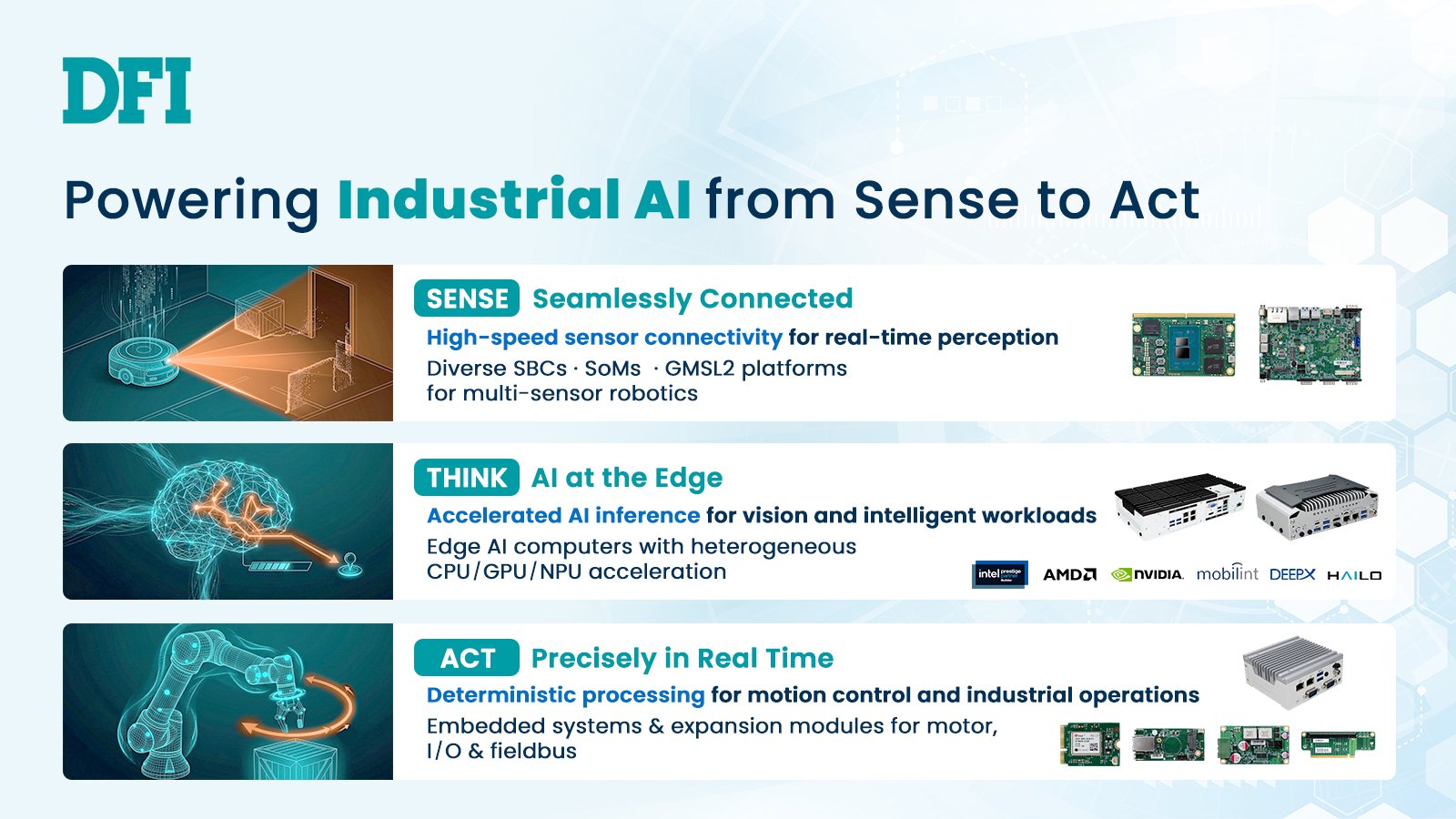
The whole Sense–Think–Act stack, from one source — skip the integration puzzle. With AI partners, DFI delivers CPUs with built-in NPUs, GPUs, and accelerators, plus the sensor I/O and expansion modules each stage needs.
## **Why Edge AI Changes Robot Compute**
As AI moves closer to industrial operations, the demands on edge AI for robots change in kind, not just degree. A machine acting in the physical world needs low-latency AI processing, deterministic control, industrial-grade reliability, and secure operation — all at once. That is why edge AI for robots makes platform design far more decisive than raw computing performance.
Why does so much of this compute need to run on the machine rather than in the cloud? In real-time operation, a round-trip to a data center is often too slow — and latency, reliability, bandwidth, and data privacy all tend to push intelligence toward the edge, onto the robot itself.
What makes industrial robot compute different from a general-purpose computer:
- Long lifecycle — available and supportable across a robot's decade-long service life.
- Fanless & wide-temperature — stable in enclosed, dusty, or thermally harsh environments.
- Real-time capable — deterministic control, ideally without a discrete GPU competing for cycles.
- Secure — a hardware root of trust and a disciplined update path.
- Compact & Expandable —rich I/O and expansion in a small, rugged footprint.
Platform selection matters more than raw CPU performance.
## **Physical AI Goes Beyond AI — Choose the Right Compute**
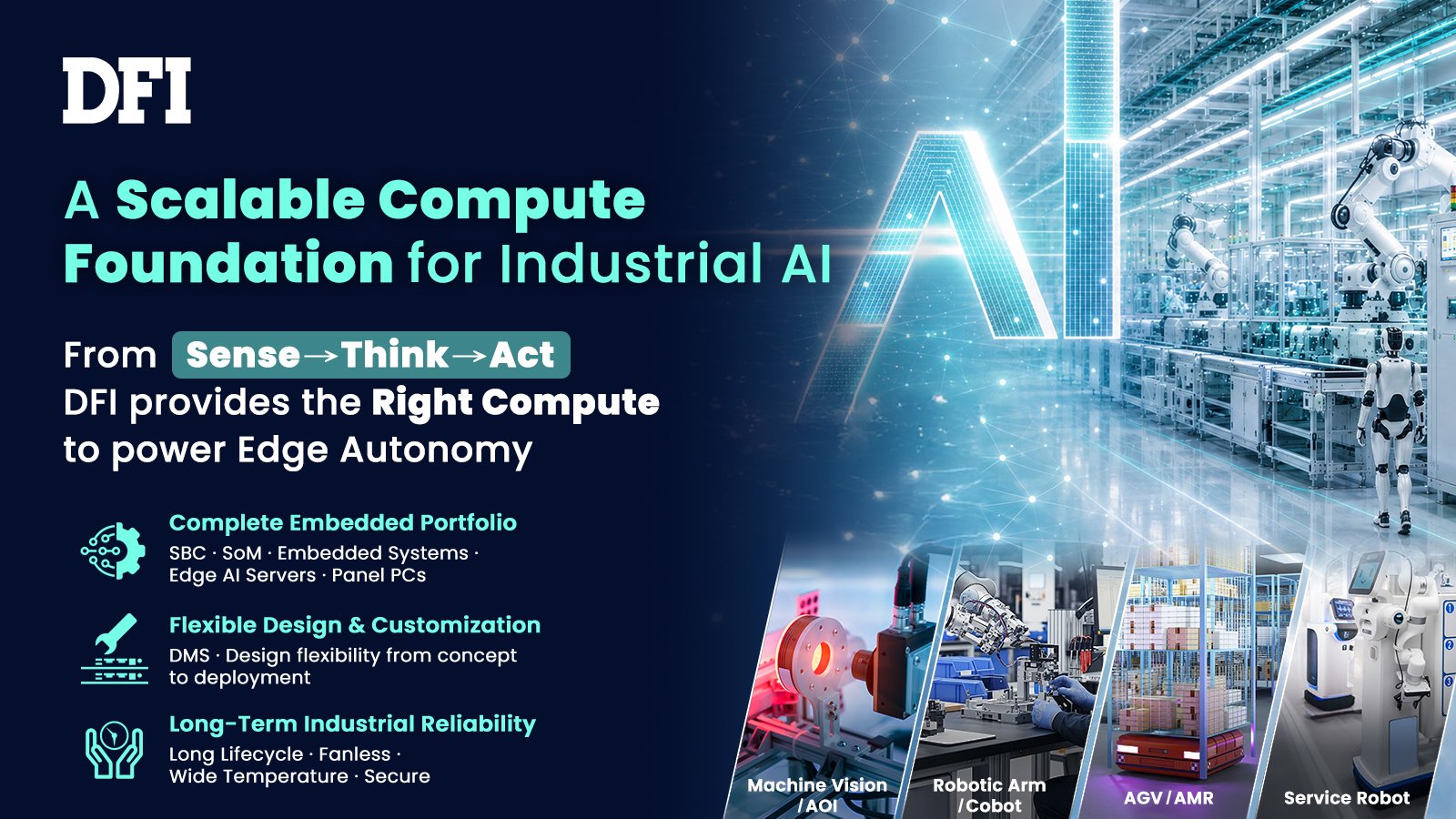
Because each stage of the loop has a different profile, choosing a robot compute platform is less about one powerful box and more about matching each node to the right class of compute. DFI's embedded portfolio spans all of them — and its flexible customization (DMS) lets builders standardize on a common compute foundation while scaling across very different Physical AI applications.
| Robot Function | Platform Class | Representative DFI Models |
| --- | --- | --- |
| Sensing node | SBC / SoM · Module | [ASL253](https://www.dfi.com/product/index/1710), [ASL600](https://www.dfi.com/product/index/1729), [QRB812](https://www.dfi.com/product/index/1708) (OSM) |
| Motion & onboard control | Embedded system (real-time) | [EB100-MTU](https://www.dfi.com/product/index/1681) (Intel TCC), [EC70A-MTH](https://www.dfi.com/product/index/1746) |
| Local AI inference | Edge-AI computer (x86 / GPU / NPU / hybrid) | [X6-MTH-ORN](https://www.dfi.com/product/index/1673) (hybrid x86 + Jetson) |
| Fleet AI / aggregation | AI server / edge server | [RM646-ERX810](https://www.dfi.com/product/index/1734) |
| Operator interface | Panel PC | [KS101P-MTH](https://www.dfi.com/product/index/1743) |
The point isn't to use every platform, but to match — and to keep room to grow. A robot shipping on an x86 board today can adopt a Core Ultra board with a built-in NPU on the same form factor as its perception needs deepen, without re-engineering the platform. In short, edge AI for robots is not one box but a matched set of platforms.
The key to lowering total cost of ownership (TCO): fewer redesigns, fewer revalidations, and a longer, more consistent product lifecycle.
→ See the full line-up: Download the [DFI Robotics Brochure](https://blog.dfi.com/hubfs/Brochure/20250626_DFI%20Application%20Brochure_Automatic%20Robot%20Solution.pdf?hsLang=en)📗
## **Scaling Physical AI with a Future-Ready Compute Foundation**
As Physical AI adoption accelerates, factors that once sat in the background move to the foreground. Long product lifecycles, cybersecurity readiness for regulations such as the EU Cyber Resilience Act (2027), and platform continuity become as decisive as AI performance — which is why a scalable, future-ready robot compute platform is now essential to any serious industrial deployment.
→ Learn more: [DFI’s EU Cyber Resilience Act Strategy](https://pages.dfi.com/cyber-resilience-act-cra-compliance?hsLang=en)
This is where deep embedded experience pays off. Backed by more than 40 years of embedded-computing expertise and flexible DMS capabilities, DFI lets OEMs build on a common compute foundation that scales across diverse Physical AI applications — from AMRs and collaborative robots to machine vision and intelligent inspection — while preserving long-term design continuity.
The lesson of this shift is simple: as Physical AI evolves, success will depend less on adding more AI, and more on choosing the right compute foundation to run it.
→ Read the deployment: [3D Warehouse Robotics Success Showcase – DFI Mini-ITX: RPP173](https://blog.dfi.com/en/rpp173-warehouse-amr-robotics?hsLang=en)
→ Read the deployment: [AMR Success Showcase – DFI AI Inference/Training System: X6-MTH-ORN](https://blog.dfi.com/en/unlocking-agility-dfi-ai-enabled-systems-with-intel-meteor-lake-processor-drive-transition-for-amrs?hsLang=en)
[](https://blog.dfi.com/hs/cta/wi/redirect?encryptedPayload=AVxigLKojuD%2FkK4iFzxJYThfVd%2F1tYki91S9gz2lDPIzaWjeqv49Ght0%2B%2Bkol%2BWSpDZeOBMp%2BgqpqoapTSjWYGdG9ewGgPnLCcoMacDPoKP5EGiPw7%2BB0aBCbi4A8Oys1e65cWOIvGum8LZY5wwqMlQfyqsqHzdr6bMlAaKDBC1GhuSbADVGUb9afA%3D%3D&webInteractiveContentId=206341415547&portalId=8330016&hsLang=en)
## **FAQ**
What is Physical AI?
AI that perceives and acts in the physical world — integrating models, sensors, and onboard compute so a machine can understand its environment and take meaningful action.
How is it different from automation?
Traditional automation repeats a fixed task on a set path; Physical AI robots sense, reason, and adapt.
Why edge computing, not cloud?
A robot acting in real time can't wait on a data-center round-trip — latency, reliability, bandwidth, and privacy push intelligence onto the machine, which is what edge AI for robots means in practice.
What compute does a robot need?
Different compute at each Sense–Think–Act stage: high-bandwidth I/O and sync for sensing, GPU/NPU for reasoning, real-time deterministic control for action.
How do OEMs choose a robot compute platform?
By matching each node to the right platform class, while prioritizing longevity, wide-temperature operation, real-time capability, and security.
AMR vs AGV?
An AGV follows fixed routes; an AMR navigates dynamically with onboard sensing and AI — which is why AMRs need more onboard compute.
References
**[\[1\]](https://nvidianews.nvidia.com/news/nvidia-and-global-robotics-leaders-take-physical-ai-to-the-real-world) NVIDIA — “NVIDIA and Global Robotics Leaders Take Physical AI to the Real World,” NVIDIA Newsroom, GTC 2026.
[\[2\]](https://ifr.org/ifr-press-releases/news/global-robot-demand-in-factories-doubles-over-10-years) International Federation of Robotics (IFR) — World Robotics 2025.
[\[3\]](https://pitchbook.com/news/reports/q4-2025-robotics-physical-ai-vc-trends) PitchBook — Q4 2025 Robotics & Physical AI VC Trends.
[\[4\]](https://pitchbook.com/news/articles/apptronik-raises-520m-as-vc-funding-for-humanoid-robotics-explodes-300) PitchBook — Apptronik raises $520M as VC funding for humanoid robotics explodes 300%**
 [DFI Editorial Team](https://blog.dfi.com/en/author/dfi-editorial-team)
The DFI Editorial Team specializes in embedded solutions for industrial automation, energy, transportation, medical, gaming, mission-critical, and intelligent retail sectors, providing expert insights into DFI’s innovations.
##### Share
 [](https://www.linkedin.com/sharing/share-offsite/?url=https://blog.dfi.com/en/from-automation-to-physical-ai-how-intelligent-robots-are-reshaping-industrial-operations) [](http://twitter.com/share?url=https://blog.dfi.com/en/from-automation-to-physical-ai-how-intelligent-robots-are-reshaping-industrial-operations) [](https://www.facebook.com/sharer/sharer.php?u=https://blog.dfi.com/en/from-automation-to-physical-ai-how-intelligent-robots-are-reshaping-industrial-operations)
##### Related Tags
[Trend Watch](https://blog.dfi.com/en/tag/trend-watch) [AMR](https://blog.dfi.com/en/tag/amr) [Robotic](https://blog.dfi.com/en/tag/robotic) [Automation](https://blog.dfi.com/en/tag/automation) [AGV](https://blog.dfi.com/en/tag/agv)
### Get the latest from DFI.
Keep up to date with our latest news and analysis by subscribing to our regular newsletter.

COPYRIGHT © DFI 2026. ALL RIGHTS RESERVED.
[Privacy Policy](https://www.dfi.com/privacypolicy) [Site Map](https://www.dfi.com/sitemap)
Follow us
-
-
-
-
```json
{
"@context" : "https://schema.org",
"@type" : "BlogPosting",
"author" : {
"@type" : "Person",
"name" : "DFI Editorial Team",
"url" : "https://blog.dfi.com/en/author/dfi-editorial-team"
},
"dateModified" : "2026-08-14T01:00:00.995Z",
"datePublished" : "2026-08-14T01:00:00.000Z",
"headline" : "From Automation to Physical AI: How Intelligent Robots Are Reshaping Industrial Operations",
"image" : [ "https://blog.dfi.com/hubfs/20260811_Trend%20Watch-From%20Automation%20to%20Physical%20AI_%E5%9C%961_1600x900px.jpg" ],
"mainEntityOfPage" : {
"@id" : "https://blog.dfi.com/en/from-automation-to-physical-ai-how-intelligent-robots-are-reshaping-industrial-operations",
"@type" : "WebPage"
},
"publisher" : {
"@type" : "Organization",
"logo" : {
"@type" : "ImageObject",
"url" : "https://blog.dfi.com/hubfs/DFI-Logo-2.png"
},
"name" : "DFI Inc."
}
}
```
```json
{
"@context" : "https://schema.org",
"@type" : "FAQPage",
"mainEntity" : [ {
"@type" : "Question",
"acceptedAnswer" : {
"@type" : "Answer",
"text" : "AI that perceives and acts in the physical world — integrating models, sensors, and onboard compute so a machine can understand its environment and take meaningful action."
},
"name" : "What is Physical AI?"
}, {
"@type" : "Question",
"acceptedAnswer" : {
"@type" : "Answer",
"text" : "Traditional automation repeats a fixed task on a set path; Physical AI robots sense, reason, and adapt."
},
"name" : "How is it different from automation?"
}, {
"@type" : "Question",
"acceptedAnswer" : {
"@type" : "Answer",
"text" : "A robot acting in real time can't wait on a data-center round-trip — latency, reliability, bandwidth, and privacy push intelligence onto the machine, which is what edge AI for robots means in practice."
},
"name" : "Why edge computing, not cloud?"
}, {
"@type" : "Question",
"acceptedAnswer" : {
"@type" : "Answer",
"text" : "Different compute at each Sense–Think–Act stage: high-bandwidth I/O and sync for sensing, GPU/NPU for reasoning, real-time deterministic control for action."
},
"name" : "What compute does a robot need?"
}, {
"@type" : "Question",
"acceptedAnswer" : {
"@type" : "Answer",
"text" : "By matching each node to the right platform class, while prioritizing longevity, wide-temperature operation, real-time capability, and security."
},
"name" : "How do OEMs choose a robot compute platform?"
}, {
"@type" : "Question",
"acceptedAnswer" : {
"@type" : "Answer",
"text" : "An AGV follows fixed routes; an AMR navigates dynamically with onboard sensing and AI — which is why AMRs need more onboard compute."
},
"name" : "What is the difference between an AMR and an AGV?"
} ]
}
```