---
title: "Wafer Prober Vision Computing: DFI WM130-RPS Accelerates Flexible, Seamless Upgrades"
description: "Industrial PC for semiconductor equipment: DFI WM130-RPS Mini-ITX system powers wafer prober vision with PCIe x16, 12–28V DC input and long-term supply."
image: https://blog.dfi.com/hubfs/Success%20Showcase/2026-10%20IC%20Wafer%20Prober_WM130-RPS/20261021_Wafer%20Prober%20Vision%20Computing_WM130-RPS_1600x900px.jpg
---
[](https://www.dfi.com)
Tech in Days

- [Contact](https://www.dfi.com/contact/sales)
- [About us](https://www.dfi.com/about/companyinformation)
- [TW](https://blog.dfi.com/zh-tw/wm130-rps-semiconductor-wafer-prober-vision-pc)
EN

- Contact
- About Us
EN
- [TW](https://blog.dfi.com/zh-tw/wm130-rps-semiconductor-wafer-prober-vision-pc)
- [Innovation Spotlight](https://blog.dfi.com/en/tag/innovation-spotlight) 
- [Trend Watch](https://blog.dfi.com/en/tag/trend-watch) 
- [Success Showcase](https://blog.dfi.com/en/tag/success-showcase) 
Article Tag
- 


- [Innovation Spotlight](https://blog.dfi.com/en/tag/innovation-spotlight)
- [Trend Watch](https://blog.dfi.com/en/tag/trend-watch)
- [Success Showcase](https://blog.dfi.com/en/tag/success-showcase)
[Success Showcase](https://blog.dfi.com/en/tag/success-showcase) 2026/10/29
# Wafer Prober Vision Computing: DFI WM130-RPS Accelerates Flexible, Seamless Upgrades
Table of Content
In 2026, demand for semiconductor test equipment is expected to grow significantly. SEMI forecasts a 31% increase in global semiconductor test equipment sales in 2026, reaching US$15.3 billion \[[1](https://blog.dfi.com/en/wm130-rps-semiconductor-wafer-prober-vision-pc#Reference)\]. Driven by investment in AI servers and HBM, the wafer prober market is also projected to grow at a CAGR of approximately 6.7% \[[2](https://blog.dfi.com/en/wm130-rps-semiconductor-wafer-prober-vision-pc#Reference)\].
In wafer probing equipment, vision systems support high-precision positioning and testing operations. When upgrading the computing platform, equipment manufacturers must meet evolving system requirements while preserving existing frame grabbers, cameras, and inspection software.
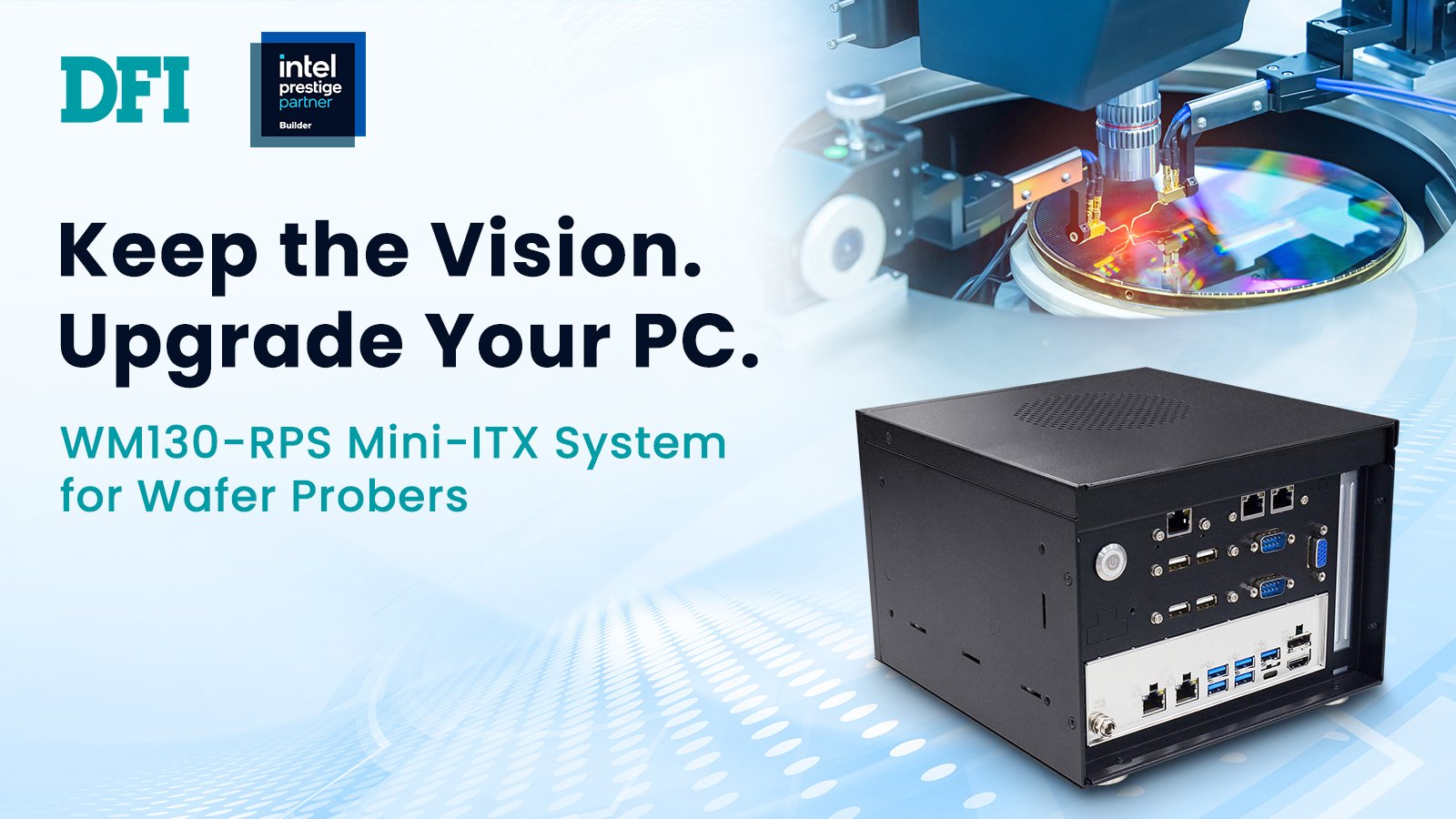
One leading Japanese semiconductor equipment manufacturer selected a platform built on DFI’s WM130-RPS, leveraging DFI’s DMS (design and manufacturing) capabilities for targeted system integration. This approach helped preserve the existing vision system while supporting the wafer prober upgrade.
Industry: Semiconductor Equipment
Country: Japan
Application: Wafer Prober Vision Inspection
Solution: DFI WM130-RPS Mini-ITX System (RPS103 Motherboard) + DMS Project-Specific Integration
## Why Is Upgrading an Industrial PC for Semiconductor Equipment So Challenging?
Challenge 1 | The Existing Vision System Must Stay Intact
A wafer prober’s vision system often includes the equipment maker’s own frame grabber, cameras and inspection software—all refined and validated over years. If a replacement PC cannot support these components and applications, the equipment maker may need additional development, compatibility testing and re-qualification, increasing project costs and schedule uncertainty.
The key is not simply to provide sufficient computing performance. The new platform must also accommodate the existing image-capture architecture and application environment.
Challenge 2 | Different Semiconductor Equipment, Different Integration Constraints
Space inside a wafer prober is limited, and different types and models of semiconductor equipment impose different integration constraints on computer dimensions, expansion-card orientation, I/O placement, dual-monitor behavior and power input.
If the replacement computer cannot accommodate these constraints, the equipment maker may also need to modify the machine’s mechanics, cabling or power architecture, adding complexity to the upgrade.
Challenge 3 | Equipment Evolves. Platform Planning Must Look Ahead
Once equipment enters mass production, platform selection affects not only current requirements but also the evolution of future product generations. As operating systems, processor generations, and I/O requirements continue to evolve, equipment manufacturers need early visibility into platform roadmaps to incorporate future computing performance, connectivity, and expansion needs into long-term product planning and prepare for the next upgrade.
| DFI’s motherboard roadmap evolves with the latest embedded CPUs, and rigorous revision control gives equipment makers early visibility into platform changes for confident cross-generation upgrades.
## How DFI Helps: A Proven Platform, Flexibly Integrated
1\. WM130-RPS | IPC Built for Industrial Applications
WM130-RPS is a compact Mini-ITX system built on the RPS103 Mini-ITX motherboard. It delivers the compute, expansion, and industrial-grade foundation that an industrial PC for semiconductor equipment demands.
• Processor: Supports Bartlett Lake-S and 12th–14th Gen Intel® Core™ processors (LGA1700, up to 65W) with Intel® R680E / H610E chipsets
• PCIe expansion: One PCIe x16 slot (Gen 5, up to 75W) for frame grabbers and other add-on cards
• Wide-voltage design: 12–28V DC input to suit the power conditions of different industrial equipment
• Flexible I/O & configuration: COM, VGA, USB, and GbE interfaces can be configured to meet equipment requirements, with DFI expansion modules available to add LAN ports for additional connectivity needs.
• Windows platform support: Runs Windows operating systems for equipment applications and platform upgrades
2\. Application-Specific System Integration
Hosting the Existing Frame Grabber
The platform’s PCIe x16 slot accepts the maker’s own frame grabber. With Gen 5 bandwidth and up to 75W of slot power, it also leaves headroom for higher-performance capture cards in future designs.
→ Value delivered: The existing image-capture architecture and inspection software can be retained, reducing the need to rebuild the vision system.
Mechanics and I/O That Fit the Equipment
Using the WM130-RPS Mini-ITX system as the foundation, DFI built a more compact chassis shaped to the prober’s mechanics and repositioned the USB, COM, VGA and LAN cutouts to match the equipment layout.
→ Value delivered: The PC drops into the existing space and cabling, so the machine design stays unchanged.
Always-On VGA: No Interruption on the Main Screen
The prober drives both a main and a sub monitor. In a typical design, unplugging one display can force the system to re-detect monitors and make the other screen flicker. DFI modified the VGA expansion module at the hardware level so it keeps outputting a signal even with no cable attached.
→ Value delivered: The main screen stays stable during maintenance or when the sub monitor is removed, so on-site operation continues uninterrupted.
Wide-Range DC Input from Equipment Power
With 12–28V wide-range DC input, the WM130-RPS integrates directly with the equipment’s internal power design, with no external adapter or additional power-conversion hardware required.
→ Value delivered: Fits existing power architectures, minimizes additional power conversion requirements, and streamlines equipment integration and power management.
## Why Equipment Makers Trust DFI
During equipment development, a supplier’s support matters as much as the product itself. When evaluating an industrial PC for semiconductor equipment, that support often decides how fast a project moves.
DFI’s technical team stays engaged through product selection, specification review, and system integration, adjusting the solution as the project evolves. From selection to deployment, DFI helps equipment makers answer four questions:
• Which configuration best fits the equipment?
• How should existing PCIe peripherals be integrated?
• How should mechanics and I/O match the equipment?
• What issues might arise in real-world operation?
| Fast response, expert support: less time on back-and-forth, more time for equipment development.
Long-Term Product Availability and Support
• Planning Beyond Today for the Next Upgrade: DFI’s motherboard roadmap continuously incorporates the latest embedded CPUs from Intel, AMD, and others. Together with long-term supply planning and product change notifications (PCNs), it helps equipment manufacturers anticipate platform evolution and evaluate future computing and I/O requirements early—providing a clearer basis for next-generation upgrades.
• Security by design: The platform includes TPM 2.0, while DFI’s IEC 62443-4-1 certification for secure product development supports a security-conscious development approach. Together, these provide useful building blocks for equipment makers planning cybersecurity across the equipment lifecycle, alongside operating-system support, network security, endpoint protection and monitoring.
## How the DFI Platform Powers Wafer Prober Vision
A wafer prober performs chip probing (CP) in wafer test. It aligns the wafer precisely beneath a probe card and brings the probes into contact with each die’s test pads. The connected automatic test equipment (ATE) then runs electrical tests, and the result is a wafer map that marks good and bad dies.
The vision system confirms that the probes are aligned and making proper contact, and the DFI platform serves as the prober’s Machine Vision PC:
• Alignment and probing: The prober moves the wafer beneath the probe card.
• Image capture: The camera captures images of the probes and contact positions.
• Frame grabber transfer: Installed in the PCIe x16 slot, the frame grabber sends images into the PC.
• Right-Sized Compute & Graphics: Powered by the Intel® Core™ 3 201TE (Bartlett Lake-S) processor, DFI platform meets this application’s display requirements using integrated graphics, without requiring a discrete GPU.
• Result output: Results appear on the main and sub monitors and are sent back to the prober controller via COM/LAN.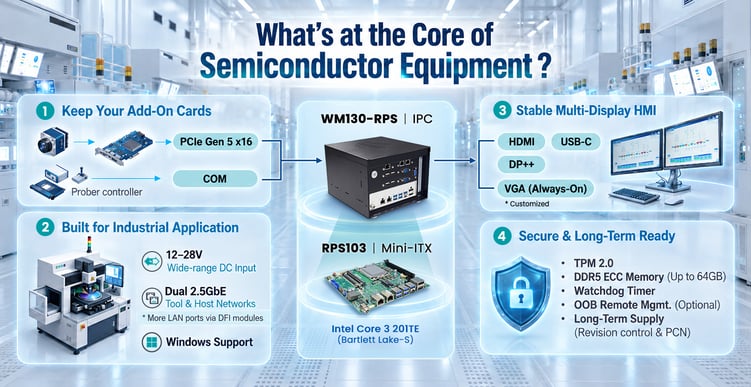
Equipment Needs vs. DFI Integration
| Equipment Need | DFI Integration | Value Delivered |
| --- | --- | --- |
| Existing vision system | PCIe x16 (Gen 5, up to 75W) | Frame grabber and inspection software carry over |
| Space and cabling | Compact chassis based on WM130-RPS; repositioned I/O cutouts | Fits existing space, no cabling changes |
| Stable on-site operation | Hardware-modified VGA module | Main screen stays on when the sub monitor is unplugged |
| Equipment power | 12–28V wide-range DC input | No external adapter; More effective power quality management |
| Compute and headroom | Intel® Core™ 3 201TE (LGA1700) | Compute platform matched to the equipment’s vision workload |
| Future platform planning | Motherboard roadmap, lifecycle planning, revision control and PCNs | Earlier visibility into platform changes and upgrade options |
| Compliance and security | CE, FCC, and UKCA compliance (CCC certification support); TPM 2.0; DFI IEC 62443-4-1 secure product development certification; [CRA program](https://pages.dfi.com/cyber-resilience-act-cra-compliance?hsLang=en) | Supports compliance preparation for target markets and helps equipment manufacturers plan product validation more systematically |
## One Upgrade, Years of Confidence | A Long-Term Partner from Development to Volume Production
DFI is now the primary platform for the maker’s wafer prober vision system, and the platform has entered volume production.
For semiconductor equipment makers, the best computer upgrade is one that keeps existing qualification results valid. Built on the proven WM130-RPS platform and DMS customization, DFI enabled the customer to complete its platform upgrade without changing its vision system, while securing stable long-term supply and room for future upgrades over years of production and service.
The same approach applies to other semiconductor equipment applications that rely on a machine vision PC, such as wafer inspection, dicing and grinding, die bonding, and test handling equipment. With more than 40 years of industrial computing experience, DFI will keep supporting customers with proven platforms and flexible integration, from equipment development all the way to long-term volume production.
## Industrial IPC, Ready for Your Application
Explore [WM130-RPS](https://www.dfi.com/product/index/1744) → | Explore [RPS101/RPS103](https://www.dfi.com/product/index/1660) →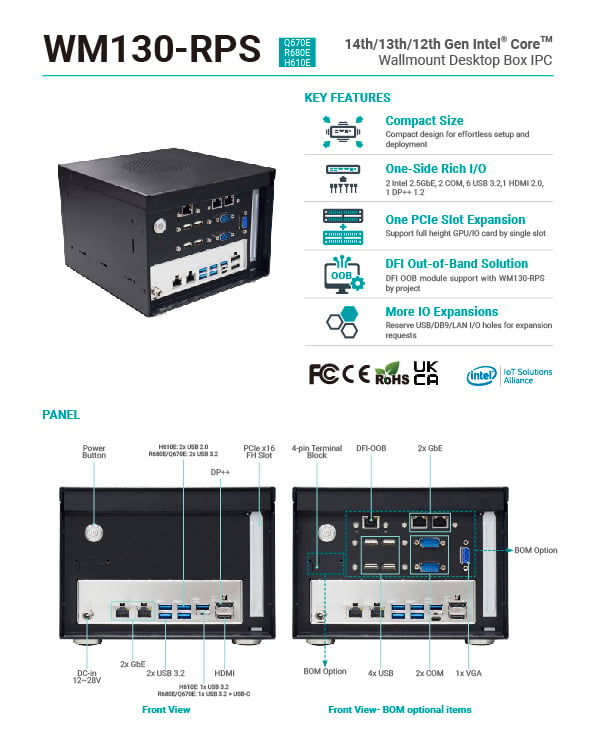
## Download Success Story
[](https://blog.dfi.com/hs/cta/wi/redirect?encryptedPayload=AVxigLInclOLkeTXcdKg%2Bi2W0koLcsEQH9HEwvIYF1tbyfAq3Y4YCJO5vA4xF2IaCfBm8wjZgPa%2FfImuVhl9GVEPdm%2BdYf1OEYe7A5WKLFgSPAwgrgWeAhR%2FYvo0ycrVjD3nO8%2B%2BYRxHvZ2UTQD12tPyZDVaQwzenE12fH%2FvkFH5rPGl795NzTHM9S6L7oQmI%2F4hfuJp8EXb1piJVTgQGYMMgorpt5DYMmcdoc85U0BNTSo5fYipjPWHIAuREHrtwWuDnkaJUFv5LhvkefrNBC2kZqKLdk6n2FQfnyU10wrrMoV%2BNAWM9Fl1sKgeLmX%2B1bH26j3yqUyjnzZXuS3D2OboNUiIMowoWR0jQz7L97hCn3%2B8T7s%3D&webInteractiveContentId=224902253587&portalId=8330016&hsLang=en)
## FAQ
What does an industrial PC for semiconductor equipment do inside a wafer prober?
In this case, the industrial PC runs the vision inspection application. It receives images from the camera through the frame grabber, analyzes probe alignment and contact, displays the results on the operator screens and reports them to the prober controller.
What should equipment makers look for in an industrial PC for semiconductor equipment?
Beyond performance, check whether the platform can host existing expansion cards and software, fit the equipment’s mechanics and I/O, and match its power requirements. Also consider the supplier’s integration support, motherboard options that scale across equipment models and CPU generations, lifecycle planning and change-notification process—factors that influence both today’s deployment and future upgrades.
Can an existing frame grabber be reused in a new machine vision PC?
Yes. As long as the new platform provides a matching PCIe/PCI interface, sufficient power and cooling, and a compatible OS and drivers validated through reliability testing, the existing frame grabber can be reused, ensuring long-term, stable operation. In this project, the maker’s original frame grabber is installed directly in the platform’s own PCIe x16 slot.
What is SEMI E187, and which security standards apply to semiconductor equipment?
SEMI E187, published by SEMI in 2022, provides a framework for assessing semiconductor equipment cybersecurity across areas such as operating-system support, network security, endpoint protection and security monitoring. The embedded computer’s TPM, OS version and update mechanisms are important considerations within that broader equipment-security plan. WM130-RPS includes TPM 2.0, and DFI’s IEC 62443-4-1 certification for secure product development supports a security-conscious approach from platform development onward.
What applications is WM130-RPS suited for?
WM130-RPS is a Mini-ITX system with PCIe expansion and 12–28V wide-range DC input. It suits equipment that needs industrial-grade computing and peripheral integration, such as semiconductor, machine vision and factory automation equipment.
References
**\[1\] [SEMI,Mid-Year Total Semiconductor Equipment Forecast,July 2026](https://www.semi.org/en/semi-press-release/global-semiconductor-equipment-sales-forecast-to-reach-a-record-229-billion-dollars-in-2028-semi-reports)
\[2\] [Mordor Intelligence,Wafer Prober Market(2026–2031)](https://www.mordorintelligence.com/industry-reports/wafer-prober-market)
\[3\] [SEMI,SEMI Publishes First Cybersecurity Standards(SEMI E187)](https://semi.org/en/standards-watch-2022-March/SEMI-publishes-first-cybersecurity-standards)**
 [DFI Editorial Team](https://blog.dfi.com/en/author/dfi-editorial-team)
The DFI Editorial Team specializes in embedded solutions for industrial automation, energy, transportation, medical, gaming, mission-critical, and intelligent retail sectors, providing expert insights into DFI’s innovations.
##### Share
 [](https://www.linkedin.com/sharing/share-offsite/?url=https://blog.dfi.com/en/wm130-rps-semiconductor-wafer-prober-vision-pc) [](http://twitter.com/share?url=https://blog.dfi.com/en/wm130-rps-semiconductor-wafer-prober-vision-pc) [](https://www.facebook.com/sharer/sharer.php?u=https://blog.dfi.com/en/wm130-rps-semiconductor-wafer-prober-vision-pc)
##### Related Tags
[Edge Computing](https://blog.dfi.com/en/tag/edge-computing) [Success Showcase](https://blog.dfi.com/en/tag/success-showcase) [Machine Vision](https://blog.dfi.com/en/tag/machine-vision) [Semiconductor](https://blog.dfi.com/en/tag/semiconductor) [Design & Manufacturing Service](https://blog.dfi.com/en/tag/design-manufacturing-service) [Intel Core](https://blog.dfi.com/en/tag/intel-core) [Mini-ITX](https://blog.dfi.com/en/tag/mini-itx)
### Get the latest from DFI.
Keep up to date with our latest news and analysis by subscribing to our regular newsletter.

COPYRIGHT © DFI 2026. ALL RIGHTS RESERVED.
[Privacy Policy](https://www.dfi.com/privacypolicy) [Site Map](https://www.dfi.com/sitemap)
Follow us
-
-
-
-
```json
{
"@context" : "https://schema.org",
"@type" : "BlogPosting",
"author" : {
"@type" : "Person",
"name" : "DFI Editorial Team",
"url" : "https://blog.dfi.com/en/author/dfi-editorial-team"
},
"dateModified" : "2026-10-29T02:00:00.903Z",
"datePublished" : "2026-10-29T02:00:00.000Z",
"headline" : "Wafer Prober Vision Computing: DFI WM130-RPS Accelerates Flexible, Seamless Upgrades",
"image" : [ "https://blog.dfi.com/hubfs/Success%20Showcase/2026-10%20IC%20Wafer%20Prober_WM130-RPS/20261021_Wafer%20Prober%20Vision%20Computing_WM130-RPS_1600x900px.jpg" ],
"mainEntityOfPage" : {
"@id" : "https://blog.dfi.com/en/wm130-rps-semiconductor-wafer-prober-vision-pc",
"@type" : "WebPage"
},
"publisher" : {
"@type" : "Organization",
"logo" : {
"@type" : "ImageObject",
"url" : "https://blog.dfi.com/hubfs/DFI-Logo-2.png"
},
"name" : "DFI Inc."
}
}
```
```json
{
"@context" : "https://schema.org",
"@type" : "FAQPage",
"mainEntity" : [ {
"@type" : "Question",
"acceptedAnswer" : {
"@type" : "Answer",
"text" : "In this case, the industrial PC runs the vision inspection application. It receives images from the camera through the frame grabber, analyzes probe alignment and contact, displays the results on the operator screens and reports them to the prober controller."
},
"name" : "What does an industrial PC for semiconductor equipment do inside a wafer prober?"
}, {
"@type" : "Question",
"acceptedAnswer" : {
"@type" : "Answer",
"text" : "Beyond performance, check whether the platform can host existing expansion cards and software, fit the equipment’s mechanics and I/O, and match its power requirements. Also consider the supplier’s integration support, motherboard options that scale across equipment models and CPU generations, lifecycle planning and change-notification process—factors that influence both today’s deployment and future upgrades."
},
"name" : "What should equipment makers look for in an industrial PC for semiconductor equipment?"
}, {
"@type" : "Question",
"acceptedAnswer" : {
"@type" : "Answer",
"text" : "Yes. As long as the new platform provides a matching PCIe/PCI interface, sufficient power and cooling, and a compatible OS and drivers validated through reliability testing, the existing frame grabber can be reused, ensuring long-term, stable operation. In this project, the maker’s original frame grabber is installed directly in the platform’s own PCIe x16 slot."
},
"name" : "Can an existing frame grabber be reused in a new machine vision PC?"
}, {
"@type" : "Question",
"acceptedAnswer" : {
"@type" : "Answer",
"text" : "SEMI E187, published by SEMI in 2022, provides a framework for assessing semiconductor equipment cybersecurity across areas such as operating-system support, network security, endpoint protection and security monitoring. The embedded computer’s TPM, OS version and update mechanisms are important considerations within that broader equipment-security plan. WM130-RPS includes TPM 2.0, and DFI’s IEC 62443-4-1 certification for secure product development supports a security-conscious approach from platform development onward."
},
"name" : "What is SEMI E187, and which security standards apply to semiconductor equipment?"
}, {
"@type" : "Question",
"acceptedAnswer" : {
"@type" : "Answer",
"text" : "WM130-RPS is a Mini-ITX system with PCIe expansion and 12–28V wide-range DC input. It suits equipment that needs industrial-grade computing and peripheral integration, such as semiconductor, machine vision and factory automation equipment."
},
"name" : "What applications is WM130-RPS suited for?"
} ]
}
```