---
title: "Decades of Expertise: DFI’s Role in Shaping the Future of Robotics"
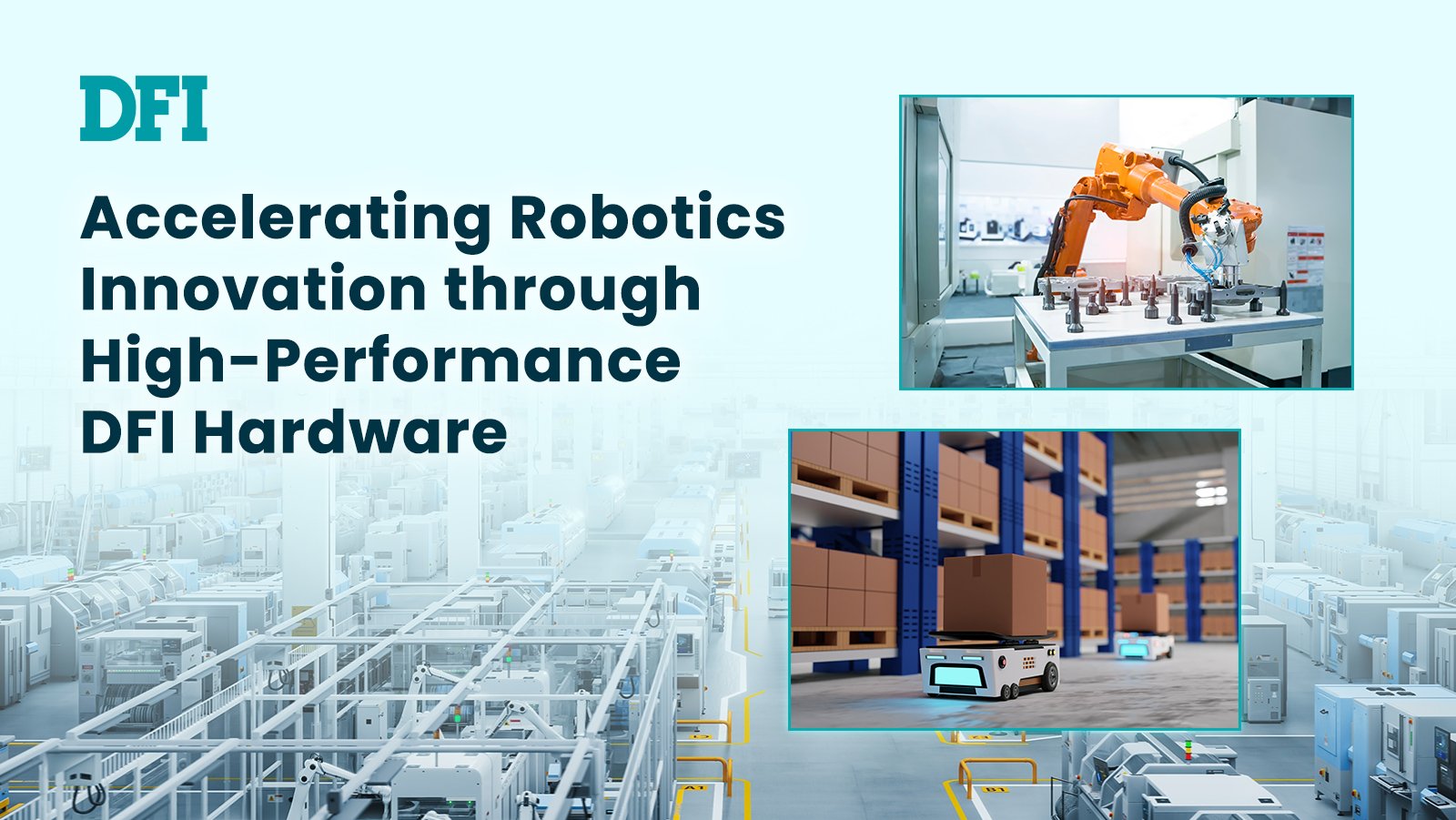
description: As artificial intelligence continues to advance and robotic hardware becomes increasingly sophisticated, the importance of reliable, industrial-grade computing platforms cannot be overstated. DFI's four decades of experience in embedded computing, combined with comprehensive technical support, customized BIOS development, and optimized hardware configurations, position the company as an ideal partner for robotics manufacturers navigating the transition to Industry 4.0. Whether developing AGVs for logistics automation, AMRs for dynamic warehouse operations, precision robotic arms for manufacturing, or humanized service robots for healthcare and hospitality, DFI's portfolio offers proven, reliable solutions that meet the demanding requirements of modern robotic applications. With industrial-grade reliability, extended product lifecycles, 24/7 durability, and the computing performance necessary to run cutting-edge AI algorithms, DFI's platforms provide the foundation for scalable, resilient, and intelligent automation across evolving industries.
image: https://blog.dfi.com/hubfs/20251223_Robotic%20success%20showcase%20article_%E5%AE%98%E7%B6%B2%E7%B8%AE%E5%9C%96_1600x900px.jpg
---
[](https://www.dfi.com)
Tech in Days

- [Contact](https://www.dfi.com/contact/sales)
- [About us](https://www.dfi.com/about/companyinformation)
- [TW](https://blog.dfi.com/zh-tw/decades-of-expertisedfis-role-in-shaping-the-future-of-robotics)
EN

- Contact
- About Us
EN
- [TW](https://blog.dfi.com/zh-tw/decades-of-expertisedfis-role-in-shaping-the-future-of-robotics)
- [Innovation Spotlight](https://blog.dfi.com/en/tag/innovation-spotlight) 
- [Trend Watch](https://blog.dfi.com/en/tag/trend-watch) 
- [Success Showcase](https://blog.dfi.com/en/tag/success-showcase) 
- 


- [Innovation Spotlight](https://blog.dfi.com/en/tag/innovation-spotlight)
- [Trend Watch](https://blog.dfi.com/en/tag/trend-watch)
- [Success Showcase](https://blog.dfi.com/en/tag/success-showcase)
[Success Showcase](https://blog.dfi.com/en/tag/success-showcase) 2025/12/26
# Decades of Expertise: DFI’s Role in Shaping the Future of Robotics
Table of Content
## The Computing Backbone of the Robotics Revolution
Since humanity first mastered fire, technological progress has been the primary engine driving civilization. The Industrial Revolution—characterized by the invention of the steam engine and the rise of mass production—redefined productivity and lifestyles, marking the dawn of the industrial age. In the 20th century, the emergence of the internet streamlined information transfer, reshaping global economies and social structures. Today, we have entered the AI era, where deep learning and big data are accelerating industrial transformations and sculpting an intelligent future. Looking ahead, the rapid evolution of robotics is shifting how we live and work, fostering a future where humans and machines collaborate toward unlimited possibilities.
Morgan Stanley forecasts a [$25 trillion](https://www.youtube.com/watch?v=Xc9CKYVuPw0) economy(global robot hardware sales) by 2050, marking a definitive shift from processing 'bits and bytes' to manipulating 'atoms and photons.' This leap into the physical realm demands an unwavering foundation. DFI provides the high-performance 'brain'— wide-range industrial-grade computing portfolio that bridges AI with physical execution. In this mission-critical landscape, where the cost of failure is absolute, DFI ensures zero-downtime reliability is the guaranteed standard for the next generation of industrial intelligence.
Industry: Robotics for Wide-Range Industries
Application: Robotic, AMR, and beyond
Solution: [**DFI’s Comprehensive Industrial Computing Portfolio for Robotics**](https://www.dfi.com/Uploads/DownloadCenter/2e9bf9e0-f70a-4ebf-b0f8-ecf5be4d6002/20250626_DFI%20Application%20Brochure_Automatic%20Robot%20Solution.pdf?timestamp=1764836006.86444)
## Advancing Robotics Through DFI Embedded Systems
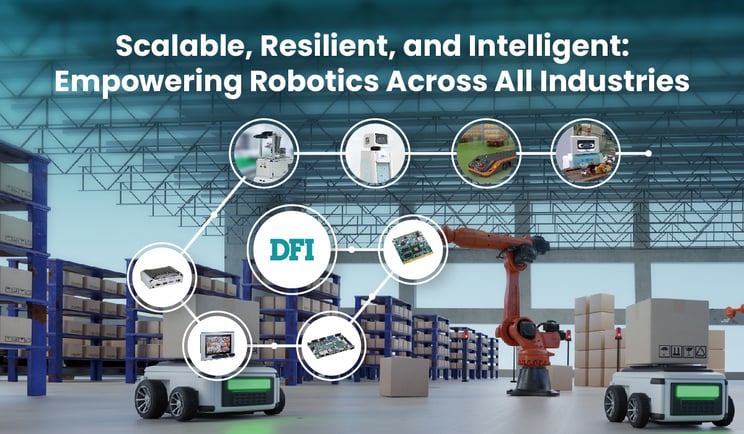
As the robotics industry evolves toward greater intelligence and autonomy, the demands on computing infrastructure have intensified dramatically. DFI, a global leader in high-performance computing technology since 1981, has emerged as a trusted partner for robotics manufacturers seeking reliable, industrial-grade computing platforms that can meet the rigorous requirements of next-generation robotic systems. DFI's comprehensive portfolio of embedded solutions addresses the critical needs of diverse robotic applications, from AGVs and AMRs to sophisticated multi-axis robotic arms and humanized service robots.
For Automated Guided Vehicles operating in warehouse and logistics environments, DFI offers platforms like the EC700-ADN, powered by Intel Processor N-series or Atom Processor X Series with built-in Out-of-Band management. Its slim, fanless design makes it ideal for space-constrained applications while onboard DDR5 memory and quad-display support via VGA/USB-C provide the performance necessary for running navigation algorithms and managing multiple camera feeds simultaneously. The integrated Intel Time Coordinated Computing (TCC) ensures deterministic real-time performance critical for safety-critical navigation decisions. For more demanding AGV applications requiring greater computational power, the EC70A-TGU leverages 11th Generation Intel Core i7/i5/i3 processors, delivering exceptional processing capability in a compact, fanless enclosure. With onboard 8GB memory expandable via SO-DIMM DDR4, triple display outputs supporting up to 4K resolution, and support for 5G-NR modules via M.2 B key interface, this platform provides the horsepower needed for advanced AI-powered path planning and real-time obstacle avoidance in dynamic warehouse environments.
Autonomous Mobile Robots, which represent a significant leap in sophistication over AGVs, demand even greater computing resources to process the massive data streams from multiple sensors while running complex AI algorithms for perception, localization, and decision-making. DFI's EC622-RPS addresses these needs with 14th/13th/12th Generation Intel Core processors paired with Intel R680E chipset, supporting up to 64GB of DDR5 memory for handling intensive machine learning workloads. The system's rich I/O connectivity—including 2.5GbE and multiple GbE ports, nine COM ports, and USB 3.2 Gen2 interfaces—enables seamless integration of diverse sensor arrays including LiDAR, cameras, ultrasonic sensors, and force-torque sensors. Five M.2 slots provide flexibility for adding storage, AI accelerators, and wireless communication modules, while the wide operating temperature range of -20 to 70°C ensures reliable performance in challenging industrial environments. For AMRs deployed in autonomous patrolling or fire-fighting applications, the ADP253 offers a balanced combination of computing power and expansion capability, with 12th Generation Intel Core processors, multiple display outputs, and comprehensive connectivity options that support the integration of thermal cameras, gas sensors, and emergency communication systems.
In material handling applications where automated picking and sorting systems must process items at high speed while maintaining accuracy, DFI's EC510-ADS and EC511-ADS series provide purpose-built solutions. These systems, powered by 12th Generation Intel Core processors with Q670E chipset, support up to 64GB DDR4 memory and offer configurations with up to four Power over Ethernet (PoE) ports—ideal for powering and connecting IP-based vision cameras without additional cabling. The triple independent display outputs and 5G communication support enable these platforms to serve as central controllers for complex material handling cells, coordinating multiple robotic arms, conveyor systems, and vision inspection stations while maintaining real-time communication with warehouse management systems. The wide operating temperature range and industrial-grade construction ensure reliable 24/7 operation in demanding logistics environments.
## Proven Foundations, Empowering Specialized Robotic Applications
For SCARA robots and multi-axis robotic arms performing precision assembly, welding, and pick-and-place operations in manufacturing environments, DFI offers specialized computing platforms that combine high performance with robust I/O capabilities. The EC500-ADS series, built on 12th Generation Intel Core processors with H610E, Q670E, or R680E chipsets, provides the real-time processing capability necessary for controlling multiple servo motors with microsecond-level precision. Rich I/O connectivity including six COM ports enables direct interfacing with motor controllers, encoders, and safety systems, while three M.2 slots support the addition of specialized motion control cards or AI accelerators for vision-guided manipulation. The compact WM130-RPS, with its optimized wall-mount chassis design for mini-ITX motherboards, offers a space-efficient solution for robotic arm controllers, with optional reserved I/O openings for additional USB and serial ports to accommodate future expansion needs. These systems excel in food and beverage production lines, where hygiene requirements demand sealed, fanless designs that can withstand washdown procedures while maintaining precise control over high-speed packaging operations.
The emergence of service robots in healthcare, hospitality, and retail environments presents unique computing challenges that balance performance, power efficiency, and human-friendly form factors. DFI's EC70A-TGU has proven particularly well-suited for medical delivery robots like Qisda's MiBot and restaurant service robots like BenQ's DiBot, offering 11th Generation Intel Core processing power in a compact, fanless package that operates quietly in patient-care and dining environments. The triple display support enables these robots to present information to users via touchscreen interfaces while simultaneously processing navigation camera feeds and communicating with building management systems. Support for 5G-NR modules ensures reliable connectivity for cloud-based AI services, enabling these robots to leverage advanced natural language processing for voice interactions and computer vision for navigating crowded spaces safely. For room sanitization robots that must operate autonomously for extended periods, the low power consumption and robust wireless connectivity of platforms like the SU551—a 7th/6th Generation Intel Core 3.5-inch SBC with 15-year CPU lifecycle support until 2030—provide the reliability and longevity essential for continuous disinfection operations in hospitals and public spaces.
## Conclusion: Building the Future of Intelligent Automation
As artificial intelligence continues to advance and robotic hardware becomes increasingly sophisticated, the importance of reliable, industrial-grade computing platforms cannot be overstated. DFI's four decades of experience in embedded computing, combined with comprehensive technical support, customized BIOS development, and optimized hardware configurations, position the company as an ideal partner for robotics manufacturers navigating the transition to Industry 4.0. Whether developing AGVs for logistics automation, AMRs for dynamic warehouse operations, precision robotic arms for manufacturing, or humanized service robots for healthcare and hospitality, DFI's portfolio offers proven, reliable solutions that meet the demanding requirements of modern robotic applications. With industrial-grade reliability, extended product lifecycles, 24/7 durability, and the computing performance necessary to run cutting-edge AI algorithms, DFI's platforms provide the foundation for scalable, resilient, and intelligent automation across evolving industries. Contact us: [Sales and Quotation|Support|DFI](https://www.dfi.com/contact/sales)
## Download Success Story
[](https://blog.dfi.com/hs/cta/wi/redirect?encryptedPayload=AVxigLII%2F7Y8HmX1KJfJAVgNrVpSEYM3GExnfj5%2FotVwjLbn40zLZgnWcz4N84DwJOXcRnlKh6jFsyJIp%2F0H%2BuibqsCLT5qoZkbw9jI7ftiAOmcjIiOKDhNUsDRbfg8vaMM7br8wn6k2BeaIt3QvkPj91CD%2FO%2FGeDzZ5KwaIoViyXBjChhDap12Mxxztmznd8fa%2BBCUPEkIDHvo3FbKzYLzrEKncMk0FyZfQkkivO9Aw488l4mkvLyqD7WtTgMxPUw%3D%3D&webInteractiveContentId=203526932096&portalId=8330016&hsLang=en)
 [DFI Editorial Team](https://blog.dfi.com/en/author/dfi-editorial-team)
The DFI Editorial Team specializes in embedded solutions for industrial automation, energy, transportation, medical, gaming, mission-critical, and intelligent retail sectors, providing expert insights into DFI’s innovations.
##### Share
 [](https://www.linkedin.com/sharing/share-offsite/?url=https://blog.dfi.com/en/decades-of-expertisedfis-role-in-shaping-the-future-of-robotics) [](http://twitter.com/share?url=https://blog.dfi.com/en/decades-of-expertisedfis-role-in-shaping-the-future-of-robotics) [](https://www.facebook.com/sharer/sharer.php?u=https://blog.dfi.com/en/decades-of-expertisedfis-role-in-shaping-the-future-of-robotics)
##### Related Tags
[Success Showcase](https://blog.dfi.com/en/tag/success-showcase) [Edge AI](https://blog.dfi.com/en/tag/edge-ai) [Robotic](https://blog.dfi.com/en/tag/robotic)
### Get the latest from DFI.
Keep up to date with our latest news and analysis by subscribing to our regular newsletter.

COPYRIGHT © DFI 2026. ALL RIGHTS RESERVED.
[Privacy Policy](https://www.dfi.com/privacypolicy) [Site Map](https://www.dfi.com/sitemap)
Follow us
-
-
-
-
```json
{
"@context" : "https://schema.org",
"@type" : "BlogPosting",
"author" : {
"@type" : "Person",
"name" : "DFI Editorial Team",
"url" : "https://blog.dfi.com/en/author/dfi-editorial-team"
},
"dateModified" : "2025-12-26T06:44:24.347Z",
"datePublished" : "2025-12-26T06:40:55.000Z",
"headline" : "Decades of Expertise: DFI’s Role in Shaping the Future of Robotics",
"image" : [ "https://blog.dfi.com/hubfs/20251223_Robotic%20success%20showcase%20article_%E5%AE%98%E7%B6%B2%E7%B8%AE%E5%9C%96_1600x900px.jpg" ],
"mainEntityOfPage" : {
"@id" : "https://blog.dfi.com/en/decades-of-expertisedfis-role-in-shaping-the-future-of-robotics",
"@type" : "WebPage"
},
"publisher" : {
"@type" : "Organization",
"logo" : {
"@type" : "ImageObject",
"url" : "https://blog.dfi.com/hubfs/DFI-Logo-2.png"
},
"name" : "DFI Inc."
}
}
```