---
title: "DFI & PEAK: Building Mission-Critical Reliability into Rugged Systems"
description: In the unforgiving reality of edge computing—where mud, rain, offshore conditions, and temperature extremes threaten critical operations—reliability is not a luxury, but a necessity. To meet these rigorous demands, DFI has engineered a versatile portfolio on the ECX Series that spans from the Intel Atom® series to high-performance 12th Gen Intel® Core™ processors, ensuring precise computing power for every deployment scale. Moving beyond standard ruggedization, we have encased these agile technical cores in an impenetrable armor capable of withstanding the harshest environmental challenges. Notably, led by the 2026 Taiwan Excellence Award-winning ECX700-ADP, the DFI ECX Series demonstrates not only robust performance across Intel® platforms but also the true capability to maintain stable operations in severe conditions. Engineered for extremes, the series features a superior IP67/69K-rated enclosure, providing ultimate protection against dust, high-pressure water ingress, and airtight sealing, further fortified by waterproof I/O connectors. This rugged design complies with MIL-STD-810H standards and ensures reliable operation across a wide temperature range. With 'PEAK Inside', the ECX Series seamlessly integrates CAN 2.0 and CAN FD, setting a new benchmark for Edge AI connectivity applications in extreme conditions.
image: https://blog.dfi.com/hubfs/DFI%20Insight_Peak%20inside%20tech_web%20banner_1600x900.jpg
---
[](https://www.dfi.com)
Tech in Days

- [Contact](https://www.dfi.com/contact/sales)
- [About us](https://www.dfi.com/about/companyinformation)
- [TW](https://blog.dfi.com/zh-tw/dfi-peak-building-mission-critical-reliability-into-rugged-systems)
EN

- Contact
- About Us
EN
- [TW](https://blog.dfi.com/zh-tw/dfi-peak-building-mission-critical-reliability-into-rugged-systems)
- [Innovation Spotlight](https://blog.dfi.com/en/tag/innovation-spotlight) 
- [Trend Watch](https://blog.dfi.com/en/tag/trend-watch) 
- [Success Showcase](https://blog.dfi.com/en/tag/success-showcase) 
- 


- [Innovation Spotlight](https://blog.dfi.com/en/tag/innovation-spotlight)
- [Trend Watch](https://blog.dfi.com/en/tag/trend-watch)
- [Success Showcase](https://blog.dfi.com/en/tag/success-showcase)
2025/12/05
# DFI & PEAK: Building Mission-Critical Reliability into Rugged Systems
Table of Content
## Hardware Meets Software for Embedded Connectivity
In the rapidly evolving landscape of industrial automation and autonomous mobility, the convergence of robust hardware and intelligent software defines operational excellence. DFI has strategically integrated embedded connectivity solutions from PEAK, powered by HMS Networks’ proven CAN/CAN FD experience, into its rugged platforms. This strong cooperation creates systems that ensure uninterrupted communication in mission-critical, unmanned, and outdoor environments.
This strategic partnership exemplifies HMS's foundational philosophy of "Hardware Meets Software," transforming DFI's rugged hardware platforms into intelligent, connected systems that maintain productivity, operational resilience, and safety standards even in the most demanding environmental conditions. As industries increasingly deploy autonomous systems in challenging environments, this integration addresses the critical need for a communication infrastructure that can withstand physical stress while maintaining data integrity and system reliability.
## Overcoming Communication Challenges in Harsh Operating Environments
Unmanned systems, including autonomous ground vehicles (AGV/UGV), unmanned surface vessels (USV) and autonomous mobile robots (AMR), depend on consistent, low-latency communication for navigation, control, and diagnostics. However, these systems frequently operate in harsh conditions that pose significant communication challenges. Signal instability caused by electromagnetic interference (EMI), mechanical vibration, and moisture exposure can distort or delay critical CAN signals, compromising system performance. The compact nature of unmanned platforms imposes severe constraints on available space and power, making traditional bulky expansion cards impractical.
Additionally, many operational fleets maintain mixed CAN 2.0 and CAN FD electronic control units (ECUs), creating dual-protocol fragmentation that demands seamless compatibility across both generations. Most critically, these applications operate in crucial situations where a single communication failure can interrupt propulsion or guidance systems, resulting in costly downtime or serious safety risks. These converging challenges necessitate compact, ruggedized, and protocol-flexible CAN connectivity solutions that deliver unwavering reliability under real-world operating conditions.

## Engineering for Industrial-proven Performance
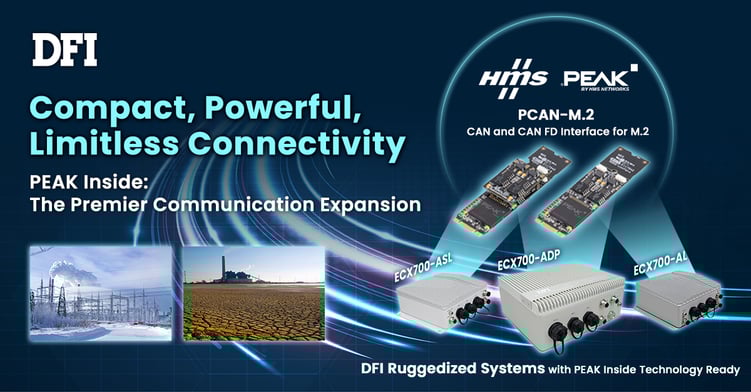
At the core of this integration lies the PEAK PCAN-M.2 Embedded CAN-FD PC Interface, a compact yet powerful solution designed specifically for demanding industrial applications. The interface utilizes a PCIe-based M.2 form factor (Type 2280/2260-B-M) supporting one, two, or four high-speed CAN channels compliant with ISO 11898-2 standards. It provides comprehensive protocol support for both CAN 2.0 A/B and CAN FD (with switchable ISO and Non-ISO modes), enabling bit rates up to 12 Mbit/s for CAN FD and 1 Mbit/s for Classic CAN.
The hardware architecture features an FPGA-based CAN FD controller paired with Microchip MCP2558FD transceivers and 300 V galvanic isolation per channel, ensuring signal integrity and system protection. Engineered for industrial-grade operation, the module functions reliably across a temperature range of -40 °C to +85 °C. Data transfer is optimized through PCIe DMA with 32-bit/64-bit addressing, delivering ultra-low latency and high throughput essential for time-critical applications. This combination of industrial durability and precision signaling brings next-generation CAN-FD communication capabilities to DFI's ruggedized embedded platforms.
## Seamless Software Integration Across Multiple Platforms
PEAK provides comprehensive software and driver support that ensures immediate deployment across diverse computing environments. The solution includes native driver support for Windows 10/11 and Linux (SocketCAN), with Linux kernel integration included in version 4.14 and above for true plug-and-play functionality. The unified API ecosystem for Windows supports higher-layer protocols including OBD-II, J1939, UDS, and CANopen, enabling developers to implement complex communication stacks efficiently. Importantly, 'PEAK Inside' facilitates industrial systems and CAN applications that leverage both edge-driven insights and industrial connectivity. This comprehensive software integration eliminates lengthy driver development cycles, allowing developers to deploy CAN connectivity instantly across multiple platforms and focus resources on application-specific functionality rather than low-level communication infrastructure.
## DFI Ruggedized Systems: ECX Series relies on PEAK
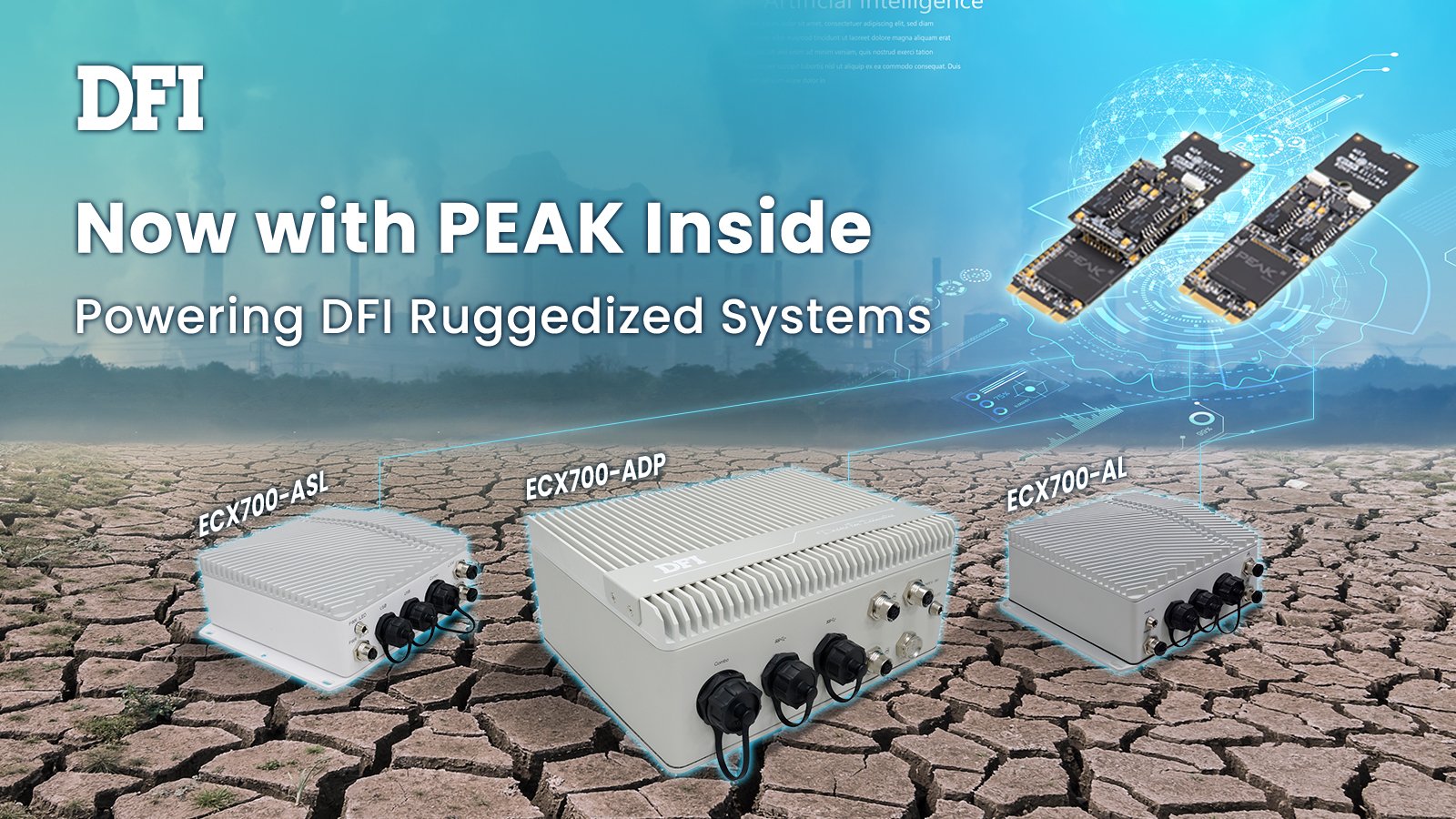
In the unforgiving reality of edge computing—where mud, rain, offshore conditions, and temperature extremes threaten critical operations—reliability is not a luxury, but a necessity. To meet these rigorous demands, DFI has engineered a versatile portfolio on the ECX Series that spans from the Intel Atom® series to high-performance 12th Gen Intel® Core™ processors, ensuring precise computing power for every deployment scale. Moving beyond standard ruggedization, we have encased these agile technical cores in an impenetrable armor capable of withstanding the harshest environmental challenges.
Notably, led by the 2026 Taiwan Excellence Award-winning ECX700-ADP, the DFI ECX Series demonstrates not only robust performance across Intel® platforms but also the true capability to maintain stable operations in severe conditions. Engineered for extremes, the series features a superior IP67/69K-rated enclosure, providing ultimate protection against dust, high-pressure water ingress, and airtight sealing, further fortified by waterproof I/O connectors. This rugged design complies with MIL-STD-810H standards and ensures reliable operation across a wide temperature range. With 'PEAK Inside', the ECX Series seamlessly integrates CAN 2.0 and CAN FD, setting a new benchmark for Edge AI connectivity applications in extreme conditions.
## Empowering the Unmanned Future Through Intelligent Connectivity
DFI's ruggedized systems deliver measurable benefits through simplified installation and seamless integration, enabling faster deployment. These platforms maintain high communication stability in environments with severe vibration, electromagnetic interference, or temperature extremes. Real-world applications prove their reliability: unmanned surface vessels achieve remote engine diagnostics, industrial automation enables high-precision motion control, and autonomous vehicles maintain reliable control that minimizes downtime. With built-in AIoT readiness, DFI systems synchronize sensor data, ECU communications, and AI processing for real-time analytics and predictive maintenance. DFI ruggedized systems with PEAK Inside bridge industrial durability and intelligent connectivity, empowering organizations to operate smarter and safer from factory floors to open-sea deployments—ready for the unmanned future.
 [DFI Editorial Team](https://blog.dfi.com/en/author/dfi-editorial-team)
The DFI Editorial Team specializes in embedded solutions for industrial automation, energy, transportation, medical, gaming, mission-critical, and intelligent retail sectors, providing expert insights into DFI’s innovations.
##### Share
 [](https://www.linkedin.com/sharing/share-offsite/?url=https://blog.dfi.com/en/dfi-peak-building-mission-critical-reliability-into-rugged-systems) [](http://twitter.com/share?url=https://blog.dfi.com/en/dfi-peak-building-mission-critical-reliability-into-rugged-systems) [](https://www.facebook.com/sharer/sharer.php?u=https://blog.dfi.com/en/dfi-peak-building-mission-critical-reliability-into-rugged-systems)
##### Related Tags
[Innovation Spotlight](https://blog.dfi.com/en/tag/innovation-spotlight) [Edge AI](https://blog.dfi.com/en/tag/edge-ai) [PEAK](https://blog.dfi.com/en/tag/peak)
### Get the latest from DFI.
Keep up to date with our latest news and analysis by subscribing to our regular newsletter.

COPYRIGHT © DFI 2026. ALL RIGHTS RESERVED.
[Privacy Policy](https://www.dfi.com/privacypolicy) [Site Map](https://www.dfi.com/sitemap)
Follow us
-
-
-
-
```json
{
"@context" : "https://schema.org",
"@type" : "BlogPosting",
"author" : {
"@type" : "Person",
"name" : "DFI Editorial Team",
"url" : "https://blog.dfi.com/en/author/dfi-editorial-team"
},
"dateModified" : "2025-12-05T03:27:37.708Z",
"datePublished" : "2025-12-05T03:23:32.000Z",
"headline" : "DFI & PEAK: Building Mission-Critical Reliability into Rugged Systems",
"image" : [ "https://blog.dfi.com/hubfs/DFI%20Insight_Peak%20inside%20tech_web%20banner_1600x900.jpg" ],
"mainEntityOfPage" : {
"@id" : "https://blog.dfi.com/en/dfi-peak-building-mission-critical-reliability-into-rugged-systems",
"@type" : "WebPage"
},
"publisher" : {
"@type" : "Organization",
"logo" : {
"@type" : "ImageObject",
"url" : "https://blog.dfi.com/hubfs/DFI-Logo-2.png"
},
"name" : "DFI Inc."
}
}
```