---
title: "The AI Robotics Revolution: Transforming Industries Through Intelligent Automation"
description: "Beyond productivity gains, robotic systems are addressing some of humanity's most pressing challenges. According to NASA’s Valkyrie project(R5) illustrates this shift, deploying robotic astronauts to high-risk environments where human presence is too dangerous or costly. These robots are expected to handle satellite repairs and planetary exploration, and explore planetary surfaces with minimal risk to human life, while gathering data that informs future crewed missions. The autonomous driving revolution, led by industry pioneers such as Tesla, showcases the potential for AI-powered vehicles to address one of the world's most lethal challenges: traffic accidents. Every year, approximately 1.19 million people die in traffic-related incidents globally, according to the WHO. By processing vast streams of sensor data in real-time and making split-second decisions with a level of consistency that humans cannot match, autonomous vehicles promise to drastically reduce these fatalities while simultaneously improving traffic flow and decreasing congestion."
image: https://blog.dfi.com/hubfs/DFI%20Insight_Robotic%20trend%20watch%20article_edm%20banner_1200x627px.jpg
---
[](https://www.dfi.com)
Tech in Days

- [Contact](https://www.dfi.com/contact/sales)
- [About us](https://www.dfi.com/about/companyinformation)
- [TW](https://blog.dfi.com/zh-tw/the-ai-robotics-revolution-transforming-industries-through-intelligent-automation)
EN

- Contact
- About Us
EN
- [TW](https://blog.dfi.com/zh-tw/the-ai-robotics-revolution-transforming-industries-through-intelligent-automation)
- [Innovation Spotlight](https://blog.dfi.com/en/tag/innovation-spotlight) 
- [Trend Watch](https://blog.dfi.com/en/tag/trend-watch) 
- [Success Showcase](https://blog.dfi.com/en/tag/success-showcase) 
- 


- [Innovation Spotlight](https://blog.dfi.com/en/tag/innovation-spotlight)
- [Trend Watch](https://blog.dfi.com/en/tag/trend-watch)
- [Success Showcase](https://blog.dfi.com/en/tag/success-showcase)
2025/12/26
# The AI Robotics Revolution: Transforming Industries Through Intelligent Automation
Table of Content
## The Dawn of a New Industrial Era
The global robotics industry stands at an inflection point, poised for unprecedented growth as artificial intelligence converges with mechanical automation to reshape how we work, manufacture, and live. According to the International Federation of Robotics (IFR) [report](https://www.therobotreport.com/ifr-industrial-robot-deployments-have-doubled-in-10-years/#:~:text=Robot%20sales%20will%20remain%20positive,Tap%20to%20unmute), the estimated market for robotic units will reach to 575,000, and with a compound annual growth rate (CAGR) of 6%, this figure is expected to surge beyond 700,000 units by 2028. This explosive growth trajectory reflects not just incremental improvements in existing technology, but a fundamental transformation in what robots can accomplish.
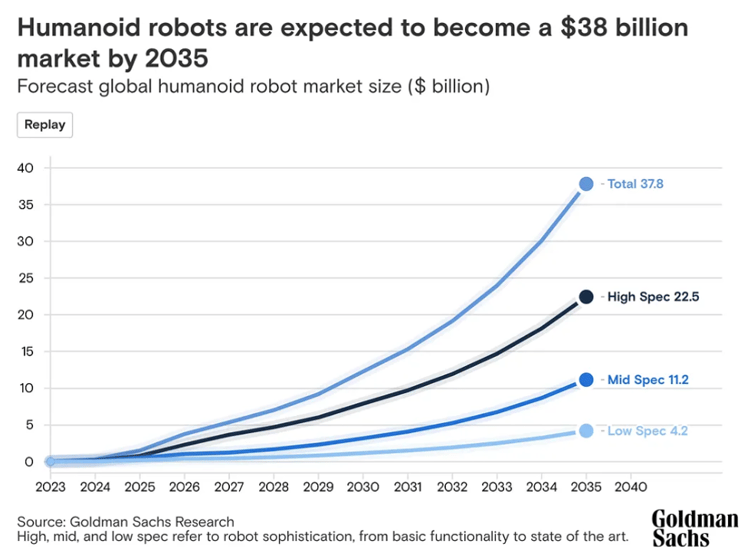
Complementing this industrial robotics boom, [Goldman Sachs](https://www.goldmansachs.com/insights/articles/the-global-market-for-robots-could-reach-38-billion-by-2035) projects that the world's humanoid robot production will generate $38 billion USD in total revenue by 2035. These figures underscore a critical shift: robots are evolving from specialized industrial tools into versatile, intelligent agents capable of navigating complex environments and performing sophisticated tasks that once required human judgment and dexterity.
## Unleashing Automation: Transforming Production and Diverse Sectors
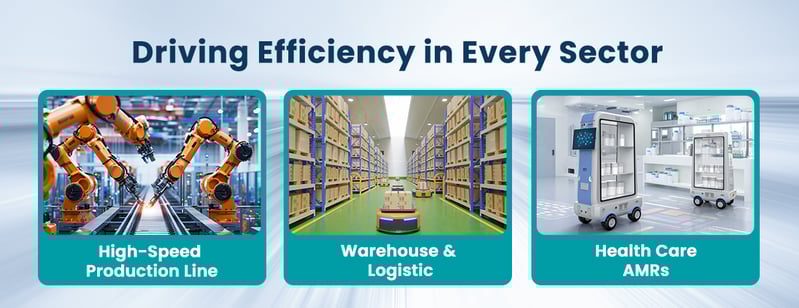
At the heart of this transformation lies smart manufacturing, where robotic systems are replacing human labor not merely to cut costs, but to achieve levels of precision, consistency, and efficiency that surpass human capabilities. Modern production lines equipped with AI-powered robots can operate continuously without fatigue, maintaining microscopic tolerances across millions of repetitive operations. In automotive manufacturing, semiconductor fabrication, and electronics assembly, these robotic systems have become indispensable, performing tasks from precision welding to delicate component placement with accuracy measured in microns. The integration of machine vision and AI-driven quality control allows these systems to identify defects in real-time, automatically adjusting parameters to maintain optimal production standards. This capability dramatically reduces waste, improves yield rates, and ensures consistent product quality that would be impossible to achieve through manual inspection alone.
The impact extends beyond traditional manufacturing sectors. In warehousing and logistics, Autonomous Mobile Robots (AMRs) and Automated Guided Vehicles (AGVs) have revolutionized material handling operations. Unlike their predecessors that followed fixed paths, modern AMRs equipped with sophisticated sensors and onboard computing can navigate dynamic warehouse environments, adapting their routes in real-time to avoid obstacles and optimize efficiency. These robots work alongside human workers in collaborative environments, handling heavy lifting and long-distance transport while humans focus on tasks requiring judgment and problem-solving. he result is a significant boost in operational efficiency, with some facilities reporting productivity increases of 30-50%) after implementing robotic automation. In the medical field, robots are transforming hospital operations through autonomous delivery of medications, laboratory samples, and supplies, reducing the burden on healthcare workers and minimizing human error in critical environments. Transportation and delivery services are experiencing similar disruptions, with autonomous vehicles and delivery robots beginning to handle last-mile logistics in urban environments, addressing the growing demand for rapid, contactless delivery services.
## Addressing Critical Challenges Through Robotic Innovation
Beyond productivity gains, robotic systems are addressing some of humanity's most pressing challenges. According to NASA’s Valkyrie project([R5](https://www.nasa.gov/technology/r5/) ) illustrates this shift, deploying robotic astronauts to high-risk environments where human presence is too dangerous or costly. These robots are expected to handle satellite repairs and planetary exploration, and explore planetary surfaces with minimal risk to human life, while gathering data that informs future crewed missions. The autonomous driving revolution, led by industry pioneers such as Tesla, showcases the potential for AI-powered vehicles to address one of the world's most lethal challenges: traffic accidents. Every year, approximately 1.19 million people die in traffic-related incidents globally, according to the [WHO](https://www.who.int/news-room/fact-sheets/detail/road-traffic-injuries). By processing vast streams of sensor data in real-time and making split-second decisions with a level of consistency that humans cannot match, autonomous vehicles promise to drastically reduce these fatalities while simultaneously improving traffic flow and decreasing congestion.
In emergency response scenarios, highly dynamic robots capable of overcoming obstacles are proving invaluable for search and rescue operations. These agile machines can navigate collapsed structures, traverse rough terrain, and access confined spaces that would endanger human rescuers, equipped with sensors to detect signs of life and cameras to assess structural integrity. The implications for disaster response are profound, potentially saving countless lives in earthquakes, building collapses, and other catastrophic events. Perhaps most significantly, robots are addressing the global labor shortage crisis exacerbated by aging populations in developed nations and declining birth rates. By taking on physically demanding, repetitive, or hazardous tasks, robots allow human workers to focus on higher-value activities requiring creativity, empathy, and complex problem-solving. The reduction in human error is equally important: in industries where mistakes can have catastrophic consequences—pharmaceuticals, aerospace, nuclear energy—robotic precision provides an essential safety buffer. Moreover, robots offer surprisingly low maintenance requirements compared to their productivity output, with many systems designed for continuous operation with minimal downtime, requiring only periodic servicing and component replacement.
## The Hardware-Software Convergence Powering Intelligent Robotics
The true revolution in robotics emerges from the seamless integration of advanced hardware and sophisticated AI software, creating systems that can perceive, learn, and adapt to their environments with unprecedented capability. On the hardware side, modern robots represent marvels of mechanical and electrical engineering. Advanced motion modules incorporating precision motors, gearboxes, and actuators enable fluid, human-like movement while maintaining the strength and speed advantages of mechanical systems. Next-generation battery modules utilizing lithium-ion and emerging solid-state technologies provide the energy density necessary for extended autonomous operation, while intelligent power management systems optimize consumption based on task demands. Sophisticated sensor arrays including LiDAR, ultrasonic sensors, infrared cameras, and accelerometers create a comprehensive sensory picture of the robot's environment, while high-resolution cameras equipped with specialized optics enable detailed visual perception even in challenging lighting conditions. Telecommunications modules supporting 5G connectivity and beyond ensure real-time data transmission for cloud-based processing and remote monitoring, while integrated GPS and indoor positioning systems provide precise localization capabilities. At the core of these systems, embedded PCs and processing units deliver the computational horsepower necessary for real-time decision-making, often incorporating specialized AI accelerators and GPUs to handle intensive machine learning workloads.
The software revolution powering these hardware platforms is equally transformative. Artificial Intelligence and machine learning frameworks enable robots to learn from experience, continuously improving their performance without explicit reprogramming. Large Language Models (LLMs) are beginning to give robots natural language understanding, allowing them to interpret complex verbal instructions and communicate status updates in human-friendly terms. Vision Language Models (VLMs) integrate visual perception with language understanding, enabling robots to comprehend scenes and describe what they observe or follow visual instructions. Large Multimodal Models (LMMs) extend these capabilities further, processing and reasoning across text, images, audio, and sensor data simultaneously to create rich situational awareness. Specialized models like Large Behavior Models (LBMs) focus on learning and replicating complex sequences of actions, enabling robots to master intricate tasks through demonstration rather than traditional programming. Large World Models (LWMs) create sophisticated internal representations of environments, allowing robots to predict consequences of actions and plan optimal strategies for achieving goals. This convergence of cutting-edge hardware and AI software creates robotic systems that are not merely programmable machines, but intelligent agents capable of autonomous operation in unstructured, real-world environments.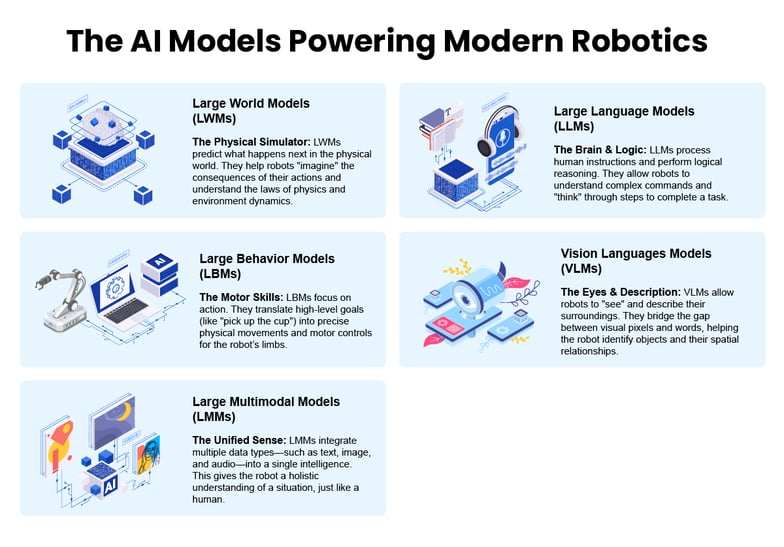
 [DFI Editorial Team](https://blog.dfi.com/en/author/dfi-editorial-team)
The DFI Editorial Team specializes in embedded solutions for industrial automation, energy, transportation, medical, gaming, mission-critical, and intelligent retail sectors, providing expert insights into DFI’s innovations.
##### Share
 [](https://www.linkedin.com/sharing/share-offsite/?url=https://blog.dfi.com/en/the-ai-robotics-revolution-transforming-industries-through-intelligent-automation) [](http://twitter.com/share?url=https://blog.dfi.com/en/the-ai-robotics-revolution-transforming-industries-through-intelligent-automation) [](https://www.facebook.com/sharer/sharer.php?u=https://blog.dfi.com/en/the-ai-robotics-revolution-transforming-industries-through-intelligent-automation)
##### Related Tags
[Trend Watch](https://blog.dfi.com/en/tag/trend-watch) [Edge AI](https://blog.dfi.com/en/tag/edge-ai) [Robotic](https://blog.dfi.com/en/tag/robotic)
### Get the latest from DFI.
Keep up to date with our latest news and analysis by subscribing to our regular newsletter.

COPYRIGHT © DFI 2026. ALL RIGHTS RESERVED.
[Privacy Policy](https://www.dfi.com/privacypolicy) [Site Map](https://www.dfi.com/sitemap)
Follow us
-
-
-
-
```json
{
"@context" : "https://schema.org",
"@type" : "BlogPosting",
"author" : {
"@type" : "Person",
"name" : "DFI Editorial Team",
"url" : "https://blog.dfi.com/en/author/dfi-editorial-team"
},
"dateModified" : "2026-01-15T03:33:34.382Z",
"datePublished" : "2025-12-26T06:00:05.000Z",
"headline" : "The AI Robotics Revolution: Transforming Industries Through Intelligent Automation",
"image" : [ "https://blog.dfi.com/hubfs/DFI%20Insight_Robotic%20trend%20watch%20article_edm%20banner_1200x627px.jpg" ],
"mainEntityOfPage" : {
"@id" : "https://blog.dfi.com/en/the-ai-robotics-revolution-transforming-industries-through-intelligent-automation",
"@type" : "WebPage"
},
"publisher" : {
"@type" : "Organization",
"logo" : {
"@type" : "ImageObject",
"url" : "https://blog.dfi.com/hubfs/DFI-Logo-2.png"
},
"name" : "DFI Inc."
}
}
```