---
title: "ASL600: Low-Power SMARC 2.2 SoM for Compact Edge AI"
description: Discover the ASL600, a low-power SMARC 2.2 module designed for efficient edge AI deployment in compact and rugged environments.
---
[](https://www.dfi.com)
Tech in Days

- [Contact](https://www.dfi.com/contact/sales)
- [About us](https://www.dfi.com/about/companyinformation)
- [TW](https://blog.dfi.com/zh-tw/asl600-low-power-smarc-2.2-som-for-compact-edge-ai)
EN

- Contact
- About Us
EN
- [TW](https://blog.dfi.com/zh-tw/asl600-low-power-smarc-2.2-som-for-compact-edge-ai)
- [Innovation Spotlight](https://blog.dfi.com/en/tag/innovation-spotlight) 
- [Trend Watch](https://blog.dfi.com/en/tag/trend-watch) 
- [Success Showcase](https://blog.dfi.com/en/tag/success-showcase) 
- 


- [Innovation Spotlight](https://blog.dfi.com/en/tag/innovation-spotlight)
- [Trend Watch](https://blog.dfi.com/en/tag/trend-watch)
- [Success Showcase](https://blog.dfi.com/en/tag/success-showcase)
2026/07/15
# ASL600: Low-Power SMARC 2.2 SoM for Compact Edge AI
Table of Content
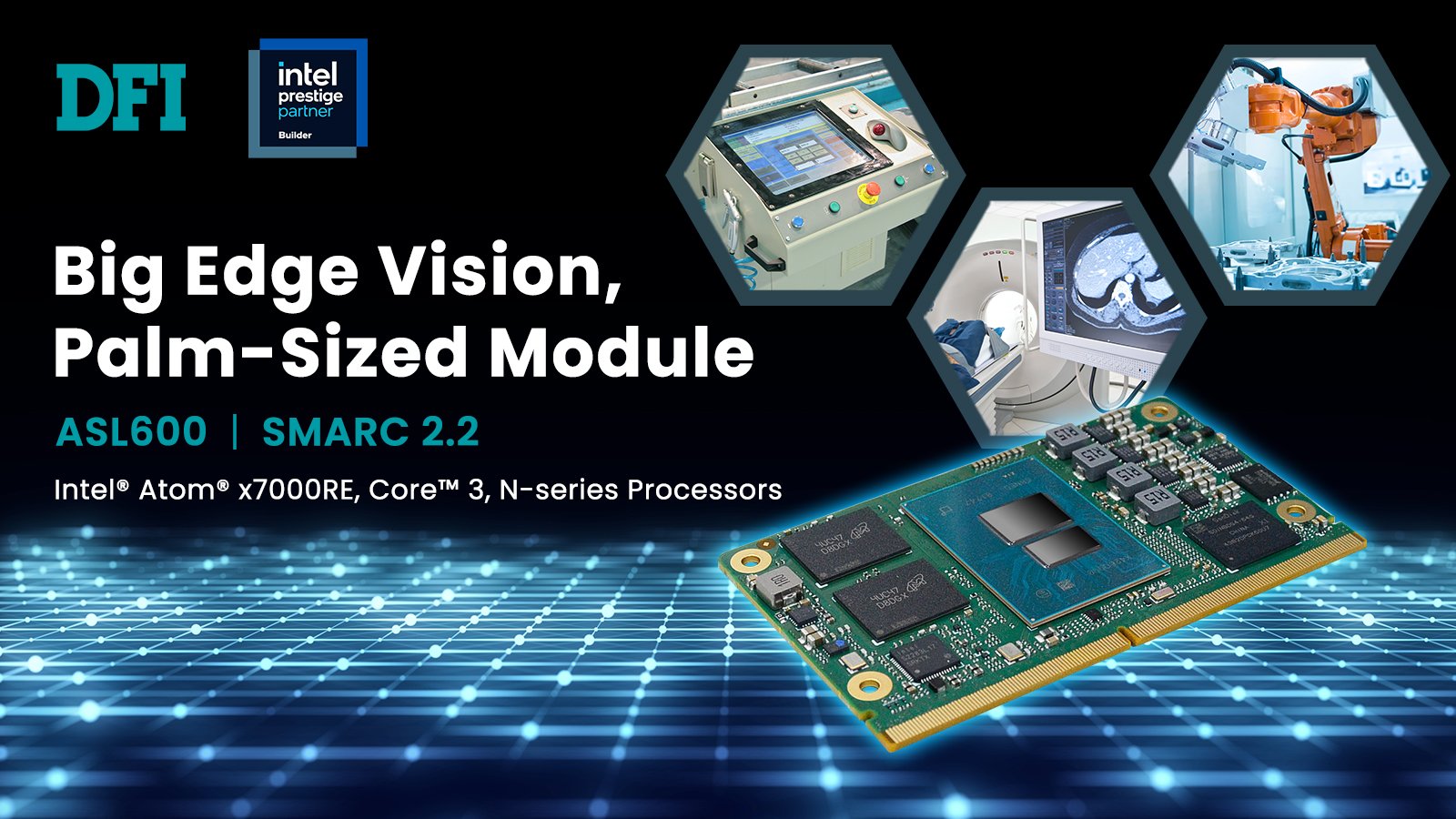
As Edge AI and machine vision applications rapidly expand across modern industrial landscapes, developers face a critical hardware hurdle: delivering reliable edge intelligence within increasingly confined, thermally challenging, and harsh operational spaces. The ASL600 directly answers this demand as a standardized SMARC 2.2 module engineered for low-power intelligent automation. Driven by energy-efficient Intel® Atom® x7000RE(Amston Lake) and Intel® Processor N-series / Core™ 3 N-series (Twin Lake) platforms, this credit-card-sized compute platform provides scalable performance configurations while safeguarding tight thermal budgets.
Without altering existing mechanical layouts, the standardized SMARC architecture of the ASL600 minimizes initial integration barriers for global OEMs. It empowers developers to deploy compact edge vision in factory automation, manage tight thermal footprints in portable medical imaging devices, and drive energy-efficient industrial HMI and smart Panel PCs. Backed by a strict long-term industrial lifecycle commitment, this modular approach safeguards long-term carrier board R&D investments and simplifies future platform migration.
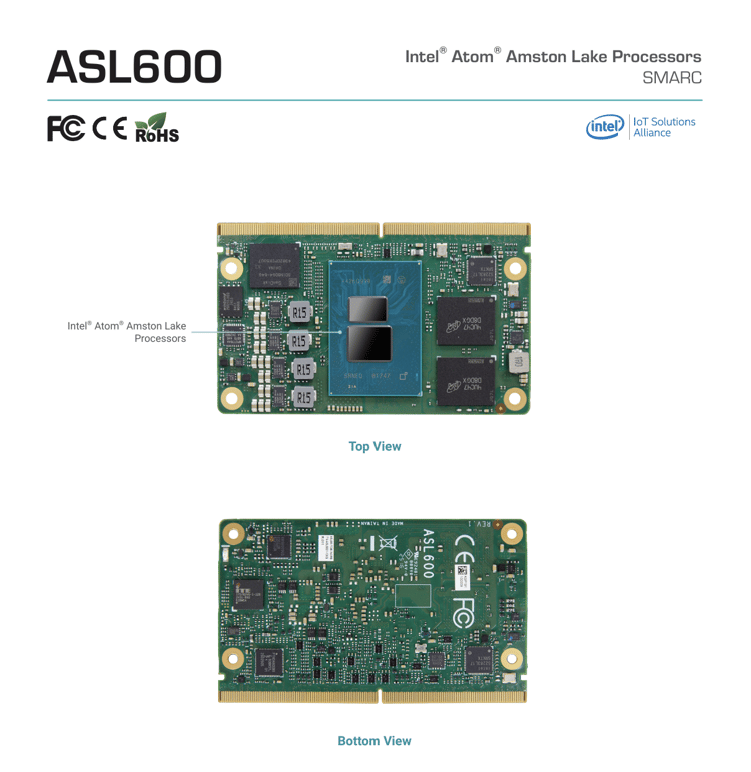
> Explore the Technical Specifications:
>
> - # [Download DFI ASL600 Datasheet](https://www.dfi.com/tw/product/index/1729#download)
---
## Built to Integrate: Solving the Real Hardware and Design Challenges of Embedded Edge Deployment

1. Extreme Spatial Limitations and Chassis Integration
How do you deploy high-performance edge computing within strict chassis boundaries? Measuring a mere 82mm x 50mm, the ASL600 delivers scalable compute performance within a credit-card-sized SMARC 2.2 form factor. This micro footprint directly addresses the strict physical boundaries of modern portable medical devices, handheld testing equipment, and compact AGV/AMR control units. It allows hardware R&D teams and OEM developers to maximize edge processing power without expanding physical enclosure limits or compromising mechanical chassis layouts.

2. Fanless Reliability and Thermal Efficiency in Harsh Environments
How do you prevent critical thermal buildup in sealed enclosures? Industrial deployment environments frequently expose edge infrastructure to volatile temperatures, airborne dust, and conductive oil grime. The ASL600 features flexible platform options with low processor TDPs that sustain optimal performance across a -40°C to 85°C wide-temperature range. By enabling fanless system integration and utilizing soldered onboard memory to mitigate shock and vibration, it eliminates mechanical points of failure to ensure consistent 24/7 reliability for long-term deployments.

3. Connectivity for Industrial Integration
Does a smaller footprint mean stripped-back I/O interfaces? Routing high-speed interfaces within an 82mm x 50mm footprint presents severe layout and signal integrity challenges. The ASL600 overcomes this by fully routing both processor platforms' high-speed interfaces onto the SMARC 2.2 edge connector. This dense routing integrates onboard MIPI-CSI alongside dual Intel® I226 2.5GbE controllers to deliver high-bandwidth data transmission for critical field networks. Simultaneously, dual native CANBus lanes manage real-time device communication and responsive AGV/AMR motion control. Furthermore, the module supports triple independent displays (LVDS/eDP, HDMI, and DDI) to directly drive information-heavy industrial HMIs and smart Panel PCs.

4. Lifecycle Built for Industrial Integration
How do you protect your carrier board R&D investments from unpredictable chip lifecycles? Supported by DFI’s strict long-term industrial lifecycle commitment, this modular core ensures stable production and reliable supply. This extended product availability protects carrier board R&D investments while lowering the Total Cost of Ownership (TCO). Global OEMs can deploy extended projects without frequent, costly re-validation or re-testing, while enabling simple SoM upgrades that simplify future platform migration.
[](https://blog.dfi.com/hs/cta/wi/redirect?encryptedPayload=AVxigLK%2BmKVVj1YbC2R43ZFMgnAhzH0S0DKSfHkmkDadVAXPNA8Hfw8gBCIZxaDFapPC8e4P01FkDfvxAmHq3%2FsO9vVwvZi1mUMjNQoCh3D4XgzPpZuibQW5PHebQb5cr0NN%2BLGI2sqtE9kvDgAfyCNTmDanzYNbQMV%2Fp6bVmjpbBdWNE2%2FFfk%2Bldw%3D%3D&webInteractiveContentId=206341415547&portalId=8330016&hsLang=en)
 [DFI Editorial Team](https://blog.dfi.com/en/author/dfi-editorial-team)
The DFI Editorial Team specializes in embedded solutions for industrial automation, energy, transportation, medical, gaming, mission-critical, and intelligent retail sectors, providing expert insights into DFI’s innovations.
##### Share
 [](https://www.linkedin.com/sharing/share-offsite/?url=https://blog.dfi.com/en/asl600-low-power-smarc-2.2-som-for-compact-edge-ai) [](http://twitter.com/share?url=https://blog.dfi.com/en/asl600-low-power-smarc-2.2-som-for-compact-edge-ai) [](https://www.facebook.com/sharer/sharer.php?u=https://blog.dfi.com/en/asl600-low-power-smarc-2.2-som-for-compact-edge-ai)
##### Related Tags
[Innovation Spotlight](https://blog.dfi.com/en/tag/innovation-spotlight) [Edge AI](https://blog.dfi.com/en/tag/edge-ai)
### Get the latest from DFI.
Keep up to date with our latest news and analysis by subscribing to our regular newsletter.

COPYRIGHT © DFI 2026. ALL RIGHTS RESERVED.
[Privacy Policy](https://www.dfi.com/privacypolicy) [Site Map](https://www.dfi.com/sitemap)
Follow us
-
-
-
-
```json
{
"@context" : "https://schema.org",
"@type" : "BlogPosting",
"author" : {
"@type" : "Person",
"name" : "DFI Editorial Team",
"url" : "https://blog.dfi.com/en/author/dfi-editorial-team"
},
"dateModified" : "2026-07-15T04:00:06.039Z",
"datePublished" : "2026-07-15T04:00:06.000Z",
"headline" : "ASL600: Low-Power SMARC 2.2 SoM for Compact Edge AI",
"mainEntityOfPage" : {
"@id" : "https://blog.dfi.com/en/asl600-low-power-smarc-2.2-som-for-compact-edge-ai",
"@type" : "WebPage"
},
"publisher" : {
"@type" : "Organization",
"logo" : {
"@type" : "ImageObject",
"url" : "https://blog.dfi.com/hubfs/DFI-Logo-2.png"
},
"name" : "DFI Inc."
}
}
```