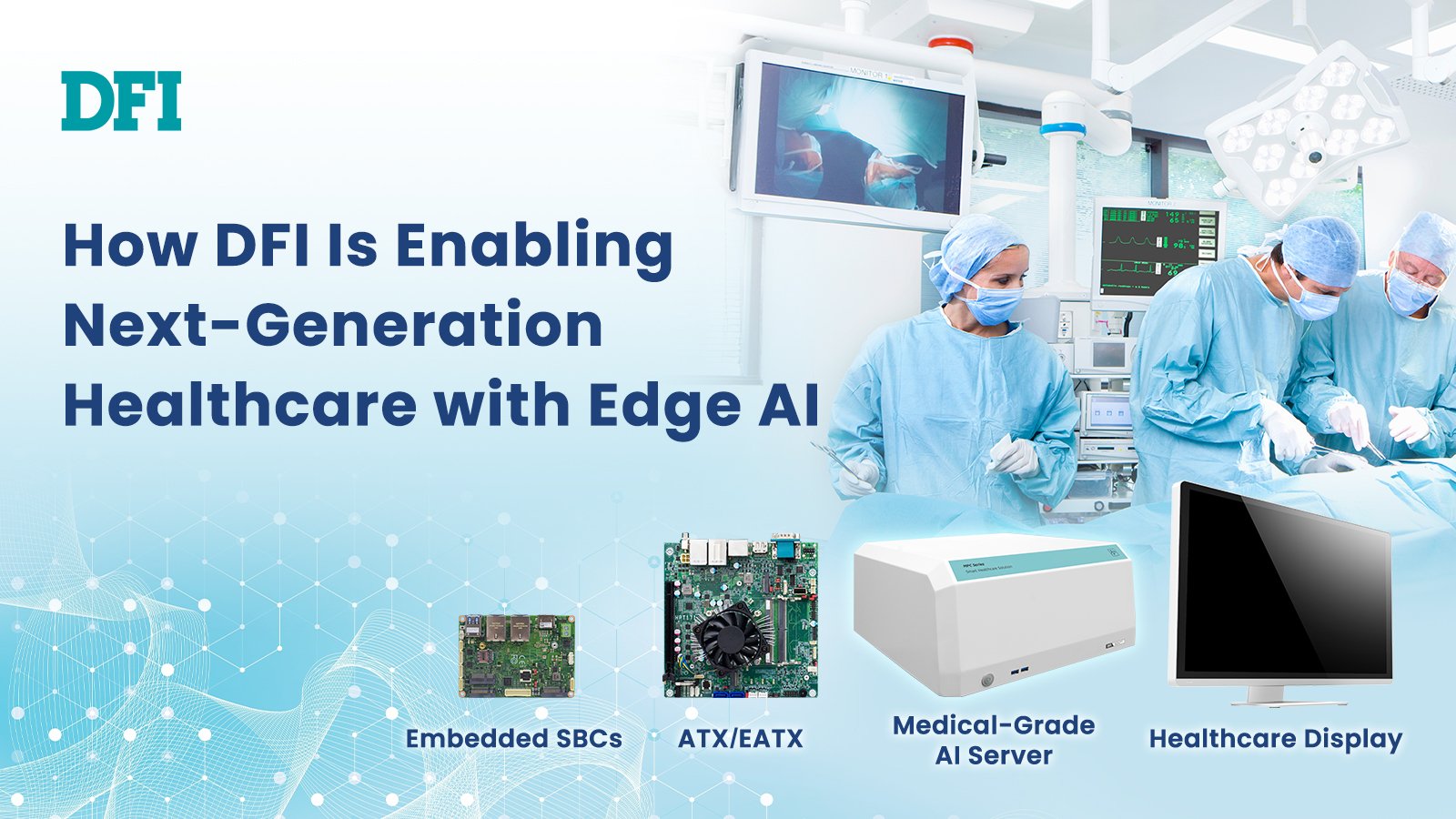
Global aging and persistent healthcare workforce shortages are accelerating the shift toward intelligent medical solutions. Coupled with the rapid advancements in Generative AI and software technologies, this is creating significant new growth opportunities for the smart healthcare market. Industry analysts expect continued expansion in smart healthcare, particularly in the areas of AI-assisted diagnosis and medical robotics.
According to a report by Marketsand Markets, the global edge computing market in the medical sector is expected to grow at a compound annual growth rate (CAGR) of 26.1%, increasing from approximately USD 4.9 billion in 2023 to an estimated USD 12.9 billion by 2028.
DFI is expanding its edge AI and medical robotics capabilities to support next-generation clinical applications. By providing a highly reliable, high-performance computing platform that serves as the core computing engine for medical devices, DFI is enabling entry into mission-critical, high-sensitivity environments such as operating rooms and emergency rooms, and firmly positioning itself as a key driver of the industry’s transformation.
Overcoming Edge AI for Real-Time, Secure, Always-On Care
The needs of the healthcare industry are rapidly evolving. The focus of smart healthcare has shifted from simply reducing labor costs and offering basic decision support to enabling real-time, high‑precision applications.
DFI’s role is to “upgrade the brain of medical devices,” with Edge AI being the key. By performing AI inference and analysis directly at the edge—on the device itself—Edge AI provides significant clinical value:
- Real-time performance and low latency:Eliminates the network delays caused by sending data to the cloud, ensuring millisecond‑level responsiveness for highly sensitive applications such as surgical navigation and vital‑sign monitoring.
- Data privacy and security:Medical data (PHI) remains within the hospital network or device, greatly reducing privacy risks and regulatory concerns.
- 24/7 stability and reliability:Even in environments with unstable network connectivity, Edge AI devices can maintain computation and decision-making capabilities, supporting round‑the‑clock operation in critical settings such as operating rooms and intensive care units (ICUs).
DFI Leads AI Computing in Healthcare
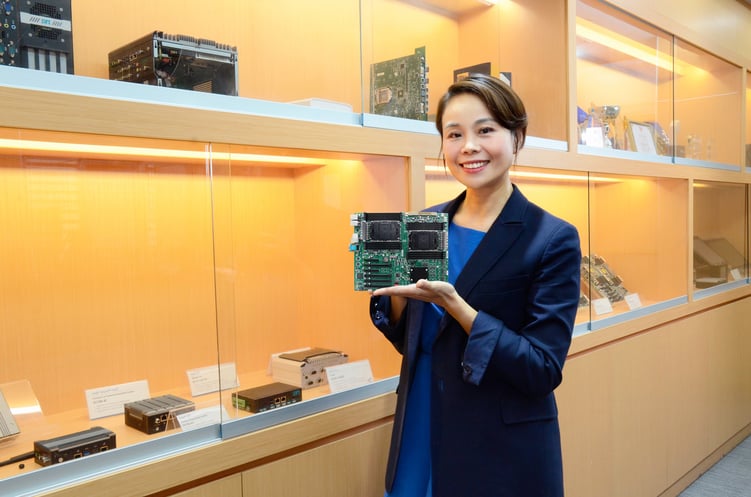
With over 40 years of deep experience in the industrial PC (IPC) sector, DFI has leveraged its long-standing expertise in highly reliable embedded computing to successfully expand into the smart healthcare domain, where reliability and regulatory requirements are extremely stringent.
More than a decade ago, DFI had already targeted the high computing power demands of medical imaging and diagnostic equipment. For advanced applications such as CT, MRI, and X‑ray, it introduced embedded motherboards featuring high performance, long lifecycle support, and regulatory compliance, solidifying its position as a key player in medical applications.
Today, as smart healthcare continues to evolve, DFI’s industrial‑grade IPC platforms have become the AI computing backbone for a wide range of diagnostic and treatment systems. Their core strengths are reflected in three main areas:
- Server-class computing power and stability: DFI provides high-performance computing platforms designed specifically for medical AI model inference and 3D image reconstruction. Whether it is real-time imaging assistance in operating rooms, rapid diagnostic systems in emergency departments, or telemedicine equipment, clinicians can rely on the stable computing power these platforms deliver when processing high-frequency sensor data and large-scale image analysis, enabling fast and accurate decision-making and truly AI-assisted healthcare.
- Strict compliance with medical regulations: The core control modules of medical devices must not only deliver high-performance computing, but also comply with stringent regulatory standards. DFI’s full range of medical-grade IPC products has passed multiple certifications, including IEC 60601-1 for electrical safety, EMC for electromagnetic compatibility, as well as thermal management and insulation/isolation requirements. This ensures that systems can maintain the highest levels of safety and performance in medical environments, even under long-term operation. These advantages significantly reduce regulatory risks and development timelines for medical device manufacturers.
- Modularity and high scalability: In response to increasingly complex medical application requirements, DFI adopts modular designs and highly scalable architectures, allowing compute modules, I/O interfaces, and AI accelerator modules to be quickly adjusted and deployed according to different scenarios. Through standard form factors such as COM Express and COM-HPC, DFI offers flexible “module + carrier board” combinations to enable plug-and-play system integration. This not only lowers development complexity, but also effectively shortens product development cycles and speeds up time-to-market—making it especially suitable for diverse medical scenarios such as imaging diagnostics, medical record management, and autonomous mobile robots (AMRs).
A Complete Portfolio from Core Computing to Mobile Control
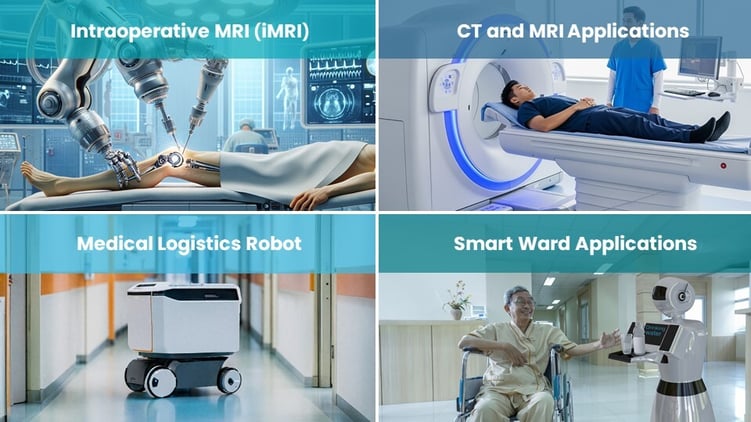
In advanced medical imaging equipment such as CT and MRI systems, the core computing module must meet demanding requirements including high-speed data throughput, real-time AI processing, and long-term operational stability. DFI provides high-performance industrial motherboards based on standard ATX and EATX form factors. Among them, the ICX610-C621A、ERX610-C741、ERX810-C741 support Intel® Xeon® Scalable processors, delivering server-class computing performance with multi-channel memory and high-speed storage interfaces. Their PCIe expansion capability enables GPU/NPU acceleration, making them ideal for high-resolution medical imaging workloads—such as CT/MRI 3D reconstruction and AI-driven image analysis.
In addition, with flexible GPU/NPU expansion—supporting AI inference cards and vision acceleration modules—medical device manufacturers can deploy deep learning models for image classification, organ/structure segmentation, and lesion detection, achieving faster and more accurate diagnostic results at the edge.
- Operating Room / Emergency Room Systems:
For environments with extremely high requirements for cleanliness and real-time performance—such as operating rooms and emergency rooms—DFI’s fanless embedded systems, such as the MPC350-RPS, feature Intel’s latest computing platforms and include a PCIe x16 expansion slot. This allows the installation of high-end NVIDIA AI graphics cards (such as the RTX series), providing powerful parallel computing capabilities.
This enables real-time processing of high-resolution medical images from multiple channels (such as CT, MRI, and endoscopic video streams) to perform complex deep learning model inference, thereby improving diagnostic and surgical efficiency and accuracy. In addition, the fanless cooling design reduces particulate contamination and ensures highly reliable edge computing performance.
In hospital environments, Autonomous Mobile Robots (AMRs) have become a key technology for improving workflow efficiency and maintaining environmental hygiene. DFI provides embeddedQCS051specifically designed for AMRs, featuring high integration, low power consumption, and high stability. These platforms can be seamlessly integrated into medical cleaning and logistics robots. With edge computing enabling real-time decision-making, they help healthcare facilities build efficient and scalable automated mobility solutions, achieving the “last mile” of smart healthcare.
- Smart Ward Applications (Human–Machine Interface):
DFI’s MDP156 medical-grade touch panel PC is certified for medical use and is easy to clean and disinfect. It is an ideal choice for deployment in smart ward bedside systems and medical displays, providing a user-friendly interactive interface for healthcare professionals and patients.
 AI-Assisted Surgical Robots Successfully Deployed in the Indian Market
DFI has partnered with the third-largest medical equipment manufacturer in India to deploy fanless industrial computers in AI-assisted surgical robot systems. Capable of processing 3D images in real time and navigating surgical paths, the system has already supported more than 7,000 knee replacement procedures—becoming a benchmark case that showcases the clinical value created by combining AI with edge computing.
Japan and Europe remain DFI’s most established core markets. Through long-term collaboration with leading local medical equipment manufacturers, DFI’s products are widely integrated into CT, MRI, ultrasound, and endoscopic platforms, and are increasingly expanding into smart wards and medical display systems, forming a strong and stable ecosystem.
Looking ahead, DFI will continue strengthening its presence in Japan, Europe, and India, while extending its reach into high-growth regions such as the United States and Southeast Asia—capturing the substantial opportunities driven by the global expansion of smart healthcare.
Group Synergy Driving Smart Healthcare Expansion
Through resource sharing within the Qisda Group, DFI’s hardware partners and customers can more easily integrate medical-grade displays, front-end software services, AI modules, and vertical distribution channels from across the group. This accelerates the development of end-to-end solutions tailored to the needs of medical institutions in different regions. The result is not only shorter deployment timelines but also higher market adaptability and added value for DFI’s edge computing platforms.
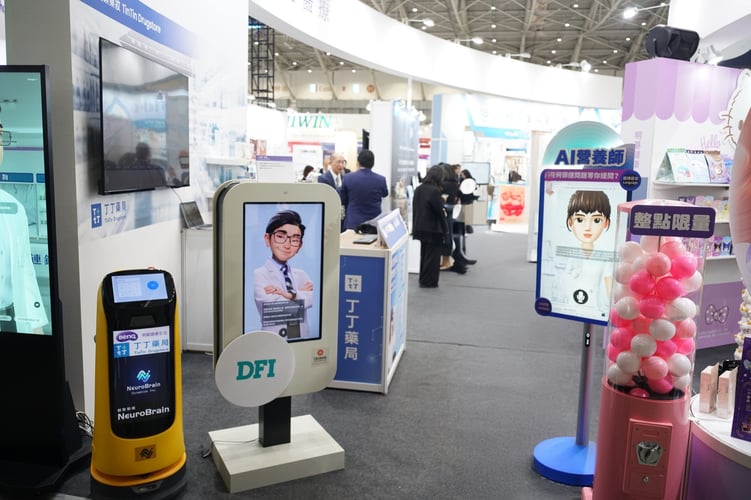
A representative example is the “AI Nutrition Assistant” deployed in Qisda’s Ding Ding Pharmacy chain. Powered by DFI’s high-performance edge computing platform, the solution delivers 24/7 continuous service and supports 30 languages, extending DFI’s computing advantages into retail and service environments. This case demonstrates the multiplier effect of group synergy—combining DFI’s computing power with Qisda’s channels and application scenarios to accelerate smart service deployment and significantly enhance user experience.
 Looking Ahead: Strengthening Leadership in AI Hardware
As AI applications continue to penetrate high-sensitivity medical environments, the importance of robust hardware computing platforms will only keep rising. From medical image analysis to operating-room applications, this is an irreversible growth trend. Moving forward, DFI will continue to refine its modular designs and scalable architectures to help partners complete system integration at a faster pace—enabling real innovation in smart healthcare and reinforcing its leadership in advanced medical AI hardware.
If you are seeking a high-performance AI computing partner that meets medical-grade standards, we invite you to explore DFI’s comprehensive product portfolio:
Contact DFI today and upgrade your smart healthcare solutions!