The Challenge: A Fleet Left Behind by the Smart City
According to a recent market report from Researchnester, the automotive V2X market is growing at a compound annual growth rate of 41.8% through 2035, with the industry projected to exceed USD 105 billion in total market value. As RSU infrastructure matures across European cities, vehicle fleets are being pushed into a period of comprehensive upgrade.
For this European police force, the challenge was immediate and tangible. The agency operated a large number of active-duty patrol vehicles that lacked any built-in edge computing capability or modern communication protocols. These vehicles were unable to interface with the smart-city infrastructure being deployed around them — no Vehicle-to-Infrastructure (V2I) communication, no real-time data feeds, no automated license plate recognition. Officers were effectively operating blind to the digital layer of the city they were protecting.
Replacing the entire fleet outright was neither financially viable nor operationally practical. The agency's procurement requirements were unambiguous: the solution had to support aftermarket retrofit installation into existing vehicles, integrate rapidly with minimal installation complexity and cost, and be capable of scaling across the full fleet. It also had to satisfy stringent European vehicle and communications certifications. DFI was selected as the technology partner.
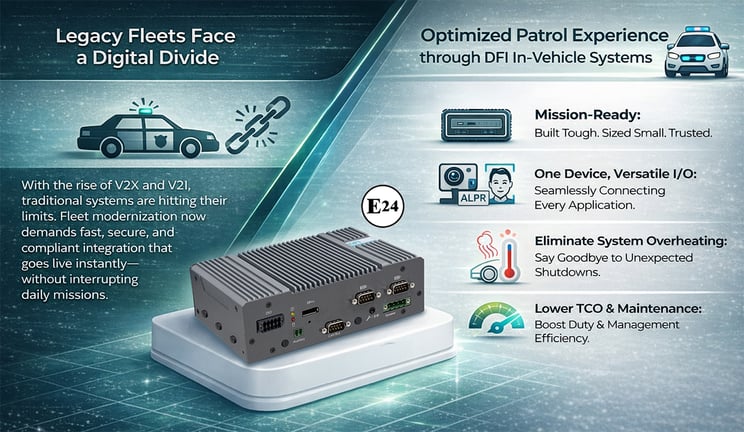
DFI In-Vehicle System VC700-ASL — Built for the Road, Ready for the Mission
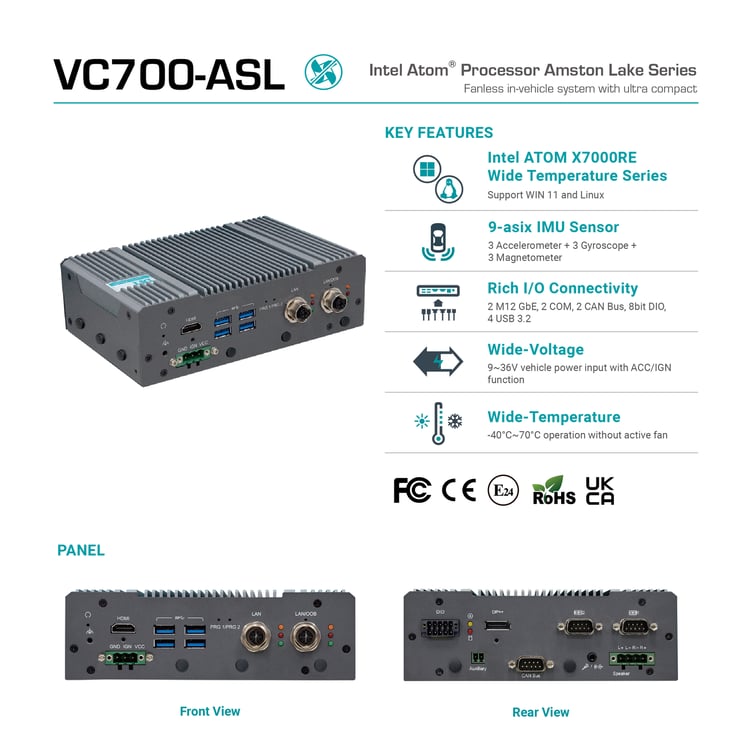
The DFI VC700-ASL is a fanless, ultra-slim in-vehicle computing system certified to E-Mark (E24) standards. At just 61.5mm in height, it was designed to fit within the limited storage and glove-box spaces found in standard patrol vehicles, while delivering enterprise-grade computing performance and multi-protocol connectivity. Five key areas of the product addressed the police force's specific operational requirements:
1. High-Efficiency Edge Computing and Scalable AI Image Recognition
At the heart of every modern policing operation is automated recognition technology. The VC700-ASL is powered by the Intel Atom® X7000RE series processor, engineered for efficient compute performance in thermally constrained, fanless environments. Its M.2 expansion interface supports AI accelerator cards from leading vendors including MemryX, Hailo, and DeepX, enabling the system to run inference workloads directly at the edge — no cloud round-trip required.
Practical AI applications deployed on these patrol vehicles include:
- Automatic License Plate Recognition (ALPR/ANPR) across multiple simultaneous camera feeds
- Illegal parking detection and automated violation logging
- Facial recognition for real-time identification of wanted persons
- Video analytics for enhanced officer situational awareness in complex environments
The system supports FP32, FP16, and INT8 inference precision alongside OpenCL 3.0, making it compatible with contemporary edge AI deployment frameworks. This allows the agency to update or expand AI models over time — without requiring hardware changes.
2. Ruggedized Design for Demanding Field Conditions
Patrol environments are inherently unpredictable. Hardware reliability is the top procurement criterion for law enforcement agencies, and the VC700-ASL was engineered from the ground up to deliver that reliability across every operating condition officers may encounter.
- Wide operating temperature range of -40°C to +70°C, covering everything from freezing Nordic winters to baking summer deployments in southern Europe
- Wide voltage input of 9–36V DC with ignition control (ACC/IGN), protecting the device against voltage spikes common during engine starts and stops
- MIL-STD-810G certified for shock and vibration resistance, ensuring stable operation during high-speed pursuits or rough-terrain patrol
- Fanless thermal design eliminates moving parts, dramatically reducing maintenance overhead and field failure risk in dusty or high-humidity environments
- DFI Out-of-Band (OOB) management enables remote device control, providing enhanced flexibility and efficiency for fleet operations.
The E-Mark (E24) certification validates full compliance with European vehicle electromagnetic compatibility requirements — a mandatory condition for any electronic equipment installed in a registered vehicle across the EU.
3. Multi-Sensor Fusion and Precise Location Tracking
Police command centers depend on real-time, accurate vehicle position data. The VC700-ASL integrates a 9-axis IMU (Inertial Measurement Unit) sensor combining an accelerometer, gyroscope, and magnetometer, paired with a u-blox NEO-M9V GNSS module supporting GPS, QZSS, Galileo, GLONASS, and BeiDou satellite systems simultaneously.
Two CAN 2.0B or FD ports (DB9-M, J1939 protocol) enable deep integration with the vehicle’s own electronics. Engine status, speed, fuel levels, and onboard diagnostic codes can all be captured and transmitted to dispatch in real time, supporting proactive fleet maintenance and enabling AI-assisted enforcement analytics correlated with vehicle telemetry.
4. Extensive I/O Expansion and High-Speed 5G Connectivity
A modern patrol vehicle is effectively a mobile command node. It must simultaneously connect body-worn cameras, dashcams, officer laptops, ALPR cameras, DVRs, and tablets — while maintaining a continuous high-speed uplink to headquarters. The VC700-ASL was engineered to serve as that central hub.
Key connectivity and I/O specifications deployed in this project include:
- 2x M12 X-Code Gigabit Ethernet ports — ruggedized, waterproof connectors rated for vehicle environments
- 4x USB 3.2 ports for connecting peripheral devices and evidence transfer
- Multiple M.2 slots supporting 5G/LTE modules with Nano SIM and eSIM capability for carrier flexibility
- Mini-PCIe slot and multiple FAKRA antenna holes for flexible multi-band antenna configuration across cellular, LMR, and GPS
- 2x CAN Bus (J1939) for vehicle engine and telemetry data integration
- 2x hot-swappable 2.5" SATA drive bays (optional) for high-volume video evidence storage, removable at shift end for rapid chain-of-custody transfer
The 5G uplink enables officers to upload high-definition video evidence, receive live intelligence from command, and maintain encrypted VPN connections to headquarters — all from within the vehicle, across all network conditions.
5. Ultra-Compact Form Factor with Superior Thermal Management
The VC700-ASL’s fanless, ultra-slim chassis — standing just 61.5mm tall — was a decisive factor in the retrofit project. Installers could mount the unit within the vehicle’s existing storage compartments and glove box spaces, minimizing structural modification and cutting installation labor significantly. Passive thermal management ensures continuous, silent operation with no consumable parts to replace in the field.
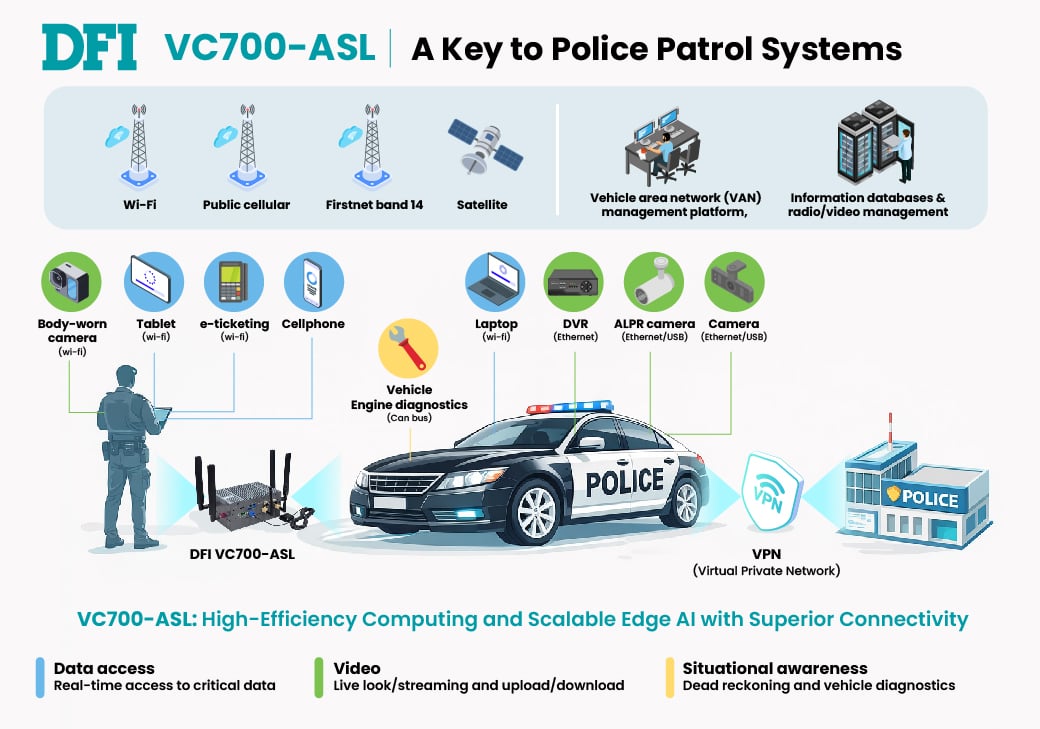
Results: A Fleet Transformed
By deploying the VC700-ASL across their retrofit program, the European police force achieved a comprehensive upgrade of their patrol capability — without the capital expenditure of a full fleet replacement. Officers now operate vehicles that are fully integrated into the surrounding smart-city infrastructure, equipped with AI recognition, precise real-time positioning, and high-speed data uplinks to command.
Operational outcomes include:
-
Significantly reduced retrofit installation time due to the VC700-ASL’s compact form factor and unified I/O design eliminating the need for multiple disparate devices.
-
Improved patrol coverage accuracy through continuous GPS and dead-reckoning position reporting, including in urban signal-blocked areas
-
Accelerated incident response enabled by real-time video streaming and integrated LMR radio connectivity
-
Enhanced enforcement efficiency through multi-lane ALPR and Edge AI-powered violation detection running locally at the edge
-
Reduced hardware downtime across the fleet, consistent with DFI’s industry-leading sub-0.1% RMA rate
Why DFI?
European public safety procurement teams consistently cite two factors when selecting DFI as their technology partner: proven reliability and exceptional manufacturing quality. Built for robust fleet deployments, the VC700-ASL is designed to reduce integration risk, lower total cost of ownership, and simplify long-term maintenance for system integrators. Crucially, the system holds E-Mark certification, satisfying the essential regulatory requirements for safe in-vehicle installation across the European Union.
Equally important is manufacturing quality. All DFI products are produced in-house to IPC Class 3 standards — the highest grade of reliability for mission-critical electronics. According to internal DFI data, this discipline produces a return merchandise authorization (RMA) rate below 0.1%: an exceptional figure for hardware operating in the harsh and unpredictable conditions of a law enforcement vehicle. For European agencies building durable, long-term fleet infrastructure, DFI’s quality track record is a primary reason the company is consistently selected as a trusted, long-term vendor.
Conclusion
The VC700-ASL demonstrates that modernizing a police fleet does not require replacing every vehicle. With the right hardware — compact, certified, ruggedized, and intelligently connected — existing patrol cars can be transformed into fully capable nodes of a smart, responsive law enforcement network. DFI’s combination of engineering depth, industry certifications, and proven manufacturing reliability makes the VC700-ASL the in-vehicle computing platform of choice for public safety agencies across Europe — and a blueprint for the next generation of intelligent patrol vehicles worldwide.
Download Success Story